
Review & Photography by Manny Manson for MPM
Wolverhampton, once again, had that crackle in the air again, that buzz only KK’s Steel Mill can summon when the right kind of chaos is coming to town. I don’t know if it was the posters, the knowledge that three generations of loud, proud, trailblazing women were about to rip the roof off the place, or just the collective electricity of a rock crowd stretching down the street in denim, studs, and anticipation, but from the moment we got into that snaking line outside KK’s, we all knew we were part of something that was going to hit hard, burn bright, and stay with us long after the ringing in our ears had faded.
Before most of us were even through the door, Chez Cane was already out among the gathering faithful, strutting around the queue like a neon lioness, posing for pictures, signing whatever people shoved in front of her, laughing with fans, hugging strangers like old friends. She didn’t look like a support act.
She looked like a headliner. Her teased black hair, ripped denim, and permanently raised eyebrow screamed ‘80s in the most unashamed and glorious way, and it felt like she’d been dragged through time from a smoky Sunset Strip dressing room straight into 2025 Wolverhampton. While a good chunk of the early crowd were inside juggling VIP photo ops with Lita and the Vixen girls, Chez took to the stage unphased, opening to a half-filled room like it was Wembley.
And goddamn, did she grab that moment.

She tore into “Too Late For Love” like a banshee with a vendetta. The song’s got that defiant, turbo-charged melodic grit that made people fall in love with the likes of Lita, Lee Aaron, and Warlock back in the day, fists in the air, a hook built like scaffolding, and a voice that’s all smoke, steel, and lipstick venom. Chez writes like she’s got a hotline to 1986 and sings like she wants to rewrite the rules. “All of It” followed, slick, sexy, dangerous, with that mid-tempo smoulder and heavy backbeat that just drips attitude. She prowled the edge of the stage, flicking her hair, pointing at punters, giving us that raised-lip sneer, the kind that make blokes melt and every woman want to pick up a microphone and light the damn world up.

Then came “I Just Want You,” a power ballad by DNA, all aching yearning, heartbreak muscle, and a chorus that landed like an uppercut to the chest. She sells it like it’s her own damn diary, stripped back in places, then roaring full-throttle, with the kind of vocal control that proves she’s not just posturing with this retro style; she’s got the chops to back it up. By the time she hit “Nationwide,” which sounds like the bastard child of early Def Leppard and Scorpions, the crowd had well and truly swelled, and she knew it. You could feel the shift. No more trickle of VIPs slipping in behind her. This was now her show.

“Ball and Chain” was sleazy, swaggering sleaze-glam at its most decadent, Mötley Crüe filtered through female rage and neon eyeliner. Then “Love Gone Wild” hit like a freight train, doubling the tempo with a defiant scream that reminded everyone that heartbreak isn’t always weepy, sometimes it’s a fucking war cry. “Get It On” and “Rock It On The Radio” were two blistering slabs of high-octane anthemic rock that felt like they should be blasting out the window of a Mustang on the PCH at sunset. Chez danced, strutted, and shimmied like she was born on MTV’s Headbangers Ball, and yet it never felt forced. She’s of that era but not imitating it, more like resurrecting it with vengeance.

She closed with “Power Zone,” the unofficial title track of her whole damn vibe. All attitude, all adrenaline, and all-in. It’s a stadium rock killer with one foot on the monitor and the other kicking the door in. The crowd gave her a roar she’ll be dreaming about for a while, and rightly so, she’d just reminded everyone what a support slot should be. This wasn’t a simple warm-up; this was a warning shot.

Chez Cane may have opened the night, but she made damn sure people would remember her when they stumbled out sweaty and deaf three hours later.

Then the lights dimmed. The strobes hit. And the familiar, dirty riff of Hendrix’s “Foxy Lady” rolled over the PA. Not live, but it was a smart move, an electric prelude that did two things: reminded us how bold this band were back in their day, and how bold they still are. And just like that, Vixen stormed the stage.
Now here’s a band with more stories than a truck stop jukebox.
Formed in Minnesota in the early ‘80s by guitarist Jan Kuehnemund (RIP), Vixen were one of the very few all-female hard rock bands to crack through the hair metal glass ceiling and stick. Their self-titled debut in 1988 gave us “Edge of a Broken Heart” and “Cryin’,” two major hits that still stand up today. The follow-up, 1990’s Rev It Up, leaned even harder into the big choruses, flashy solos, and that unmistakable late- ‘80s studio sheen, with songs like “How Much Love” and “Love Is a Killer” continuing their rise. They disappeared for a while, came back with Tangerine in 1998, a grungier, less glam affair, and reformed various times over the years with lineups fluctuating, usually around the heartbeat of original drummer Roxy Petrucci.
Jan’s tragic passing in 2013 derailed what should’ve been a full classic-lineup reunion, but Vixen, ever defiant, carried on. At this show, we got one of the strongest modern lineups yet: the ever-savage Roxy behind the kit, Rosa Laricchiuta, vocal powerhouse from Quebec’s rock scene, bringing new blood and fire up front, Julia Lage on bass with her big hair and bigger groove, and Britt Lightning on lead guitar, absolutely blistering with her neon-shred precision and charisma to spare.
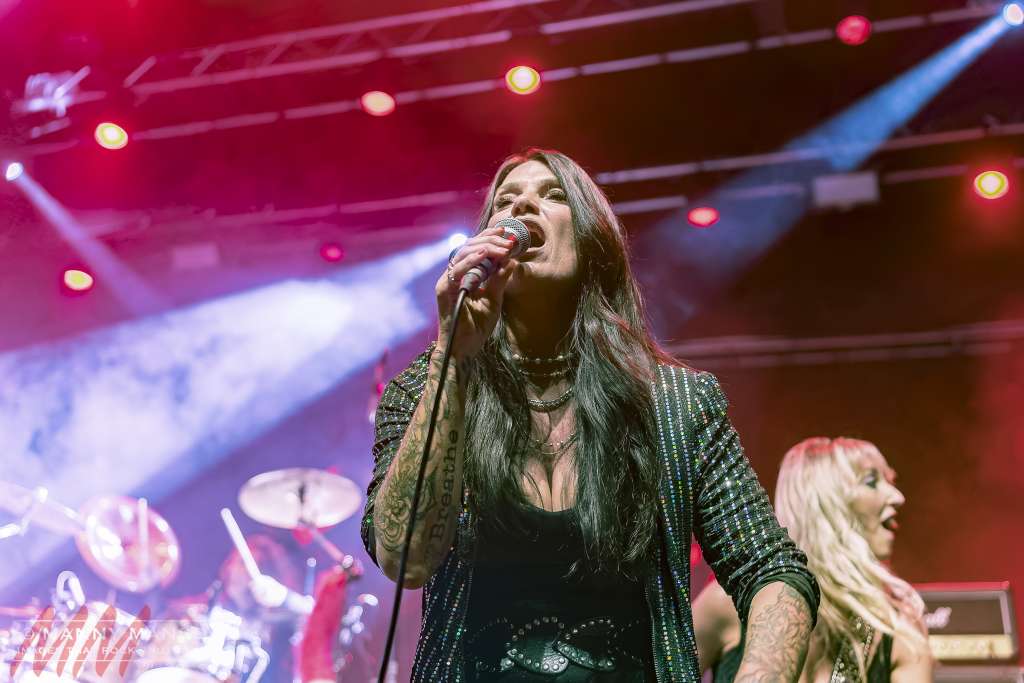
They kicked off with “Rev It Up,” all gas, no brakes, with Rosa belting it like she’d been born singing this stuff. Then came “Charmed Life,” a Jeff Paris cover, sleek, hooky, perfect for their harmony-driven sleaze. “How Much Love” brought the first proper wave of arms in the air and chorus singalongs, nobody does those harmonised ’80s vocals like Vixen, and they were tighter than a can of Aquanet (Hairspray).
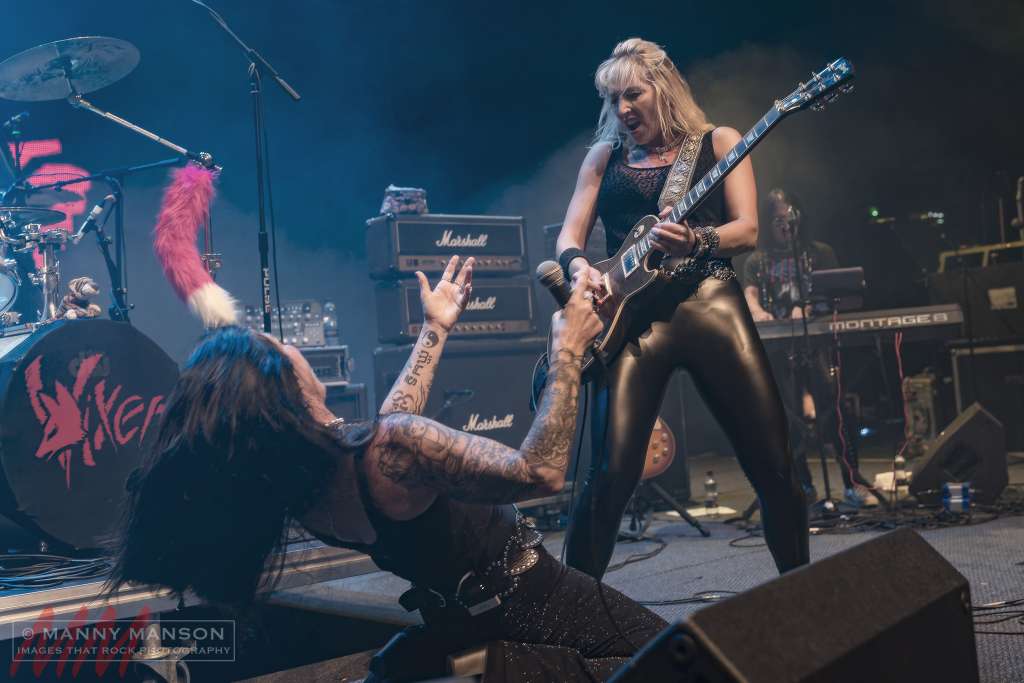
Then it got dirty, in the best way, with “Cruisin’,” and the sultry growl of “Cryin’” that followed absolutely floored the front rows. Rosa doesn’t imitate Janet Gardner, but she does justice to her legacy. She brings her own tone, her own rasp, but you still feel that core Vixen DNA burning through every note.
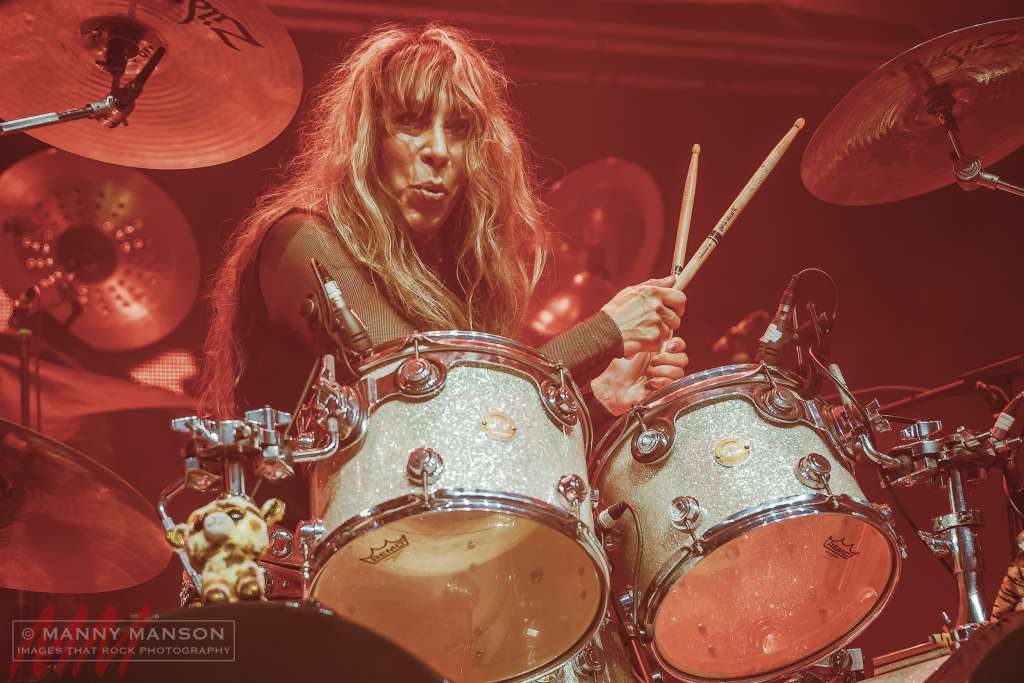
And then the covers medley came in like a ten-ton hammer. Starting with Van Halen’s “Runnin’ With the Devil,” a raucous take on their own “I Want You to Rock Me,” and into Deep Purple’s “Perfect Strangers,” which Brit absolutely destroyed on the lead breaks. Rosa did a call-out to the ‘roots of hard rock,’ and next came Rush’s “What You’re Doing,” then a barnstorming “War Pigs” soon followed, that ignited the whole crowd and had them light in their loafers. Julia laid down that Geezer-like grind with filthy precision while Roxy… Jesus. She owned it. “Still of the Night,” continued the nod to the fallen, this time to the late John Sykes with a blistering piece of guitar work by Britt.
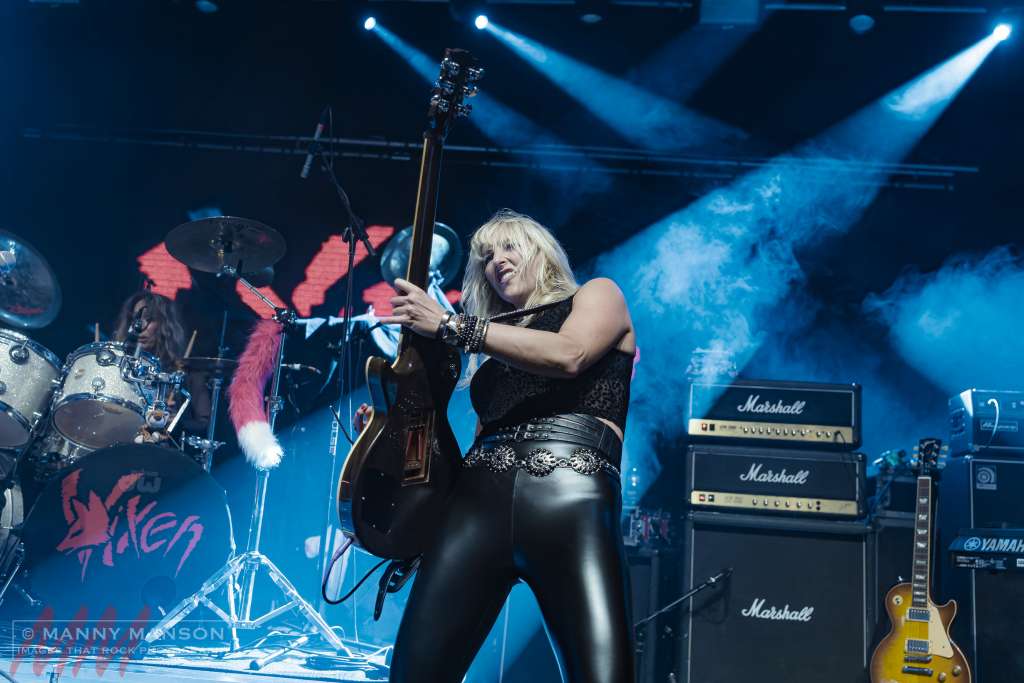
Roxy then broke into a drum solo that started slow and tribal and turned into a paradiddle masterclass. When the rest of the band finally came back in, it was chaos, glorious chaos. “I Want You To Rock Me.” Finished the segue of covers with a sing along, here Rosa had us in the palm of her hand, singing along until the roof nearly came off.

They rounded out the set with “Streets in Paradise,” sleazy and melodic, and finished, how else? with “Edge of a Broken Heart.” It felt timeless. Brit tore into the solo with fire and flair, Julia and Roxy locked in like a freight train, and Rosa absolutely killed the final chorus. A couple songs on the setlist never made it—time constraints, they said, but no one was complaining. They’d come, conquered, and signed out to The Sweet’s “Fox on the Run” as the stage exit tune. Vintage choice. Massive grins all round.

Then, after a short pause, probably 20 minutes in reality, and a backdrop change revealing a writhing collage of snakes, flames, and a certain infamous red-black motif, it was time. The lights dimmed, the fog cleared, and then, out she strutted: Lita Ford, wrapped in red leather like some flame-licked spectre of rock ‘n’ roll vengeance. The leather catsuit was no accident, it had that unmistakable Black Widow hourglass marking emblazoned across it, the same as on the back drop, her logo being guarded by two of the spiders; her blonde locks caught the stage lights with every lurch of the guitar. She looked like danger and sounded even better.
She was born Lita Rossana Ford in London in 1958 and moved to the US as a child, where she picked up a guitar before puberty and never looked back. In 1975, she was handpicked by producer Kim Fowley to join the all-girl teenage rock group The Runaways, alongside Joan Jett, Cherie Currie, Sandy West and Jackie Fox. The band was a phenomenon, a firework that burned bright, fast, and fierce. By 1979, they’d imploded in a mess of egos, mismanagement and industry abuse, but they left behind classics like “Cherry Bomb,” “Queens of Noise,” and “You Drive Me Wild.”
After The Runaways, Lita disappeared for a spell, regrouped, retooled, and came back snarling with her 1983 solo debut Out for Blood, an album that was heavier, raunchier, and more guitar-focused than anything her peers were doing. 1984’s Dancin’ on the Edge followed, with songs like “Gotta Let Go” (a minor radio hit) showing her ability to meld shred with stadium hooks. But it was 1988’s Lita, her third album, that changed everything.
That record was produced by Mike Chapman and backed by RCA with serious muscle. It went platinum, spawning not only “Close My Eyes Forever” and “Kiss Me Deadly” but also “Back to the Cave,” “Falling In and Out of Love” (co-written with Nikki Sixx of Mötley Crüe), and “Blueberry.” She was everywhere: MTV, the charts, the covers of every hard rock mag on the shelves. A woman, playing lead guitar, fronting a band, shredding like a demon, and out-sexing the boys at their own game.
1990’s Stiletto kept the fire going with songs like “Hungry,” “Lisa,” and her take on “Only Women Bleed.” 1991’s Dangerous Curves gave us “Playing with Fire” and “Black Widow,” and 1995’s Black showed a more introspective side, with grungier tones creeping in.
Then she vanished again, for years. Personal struggles, motherhood, the implosion of her marriage to Jim Gillette (of Nitro fame). But she returned in 2009 with Wicked Wonderland, a heavy, industrial-tinged curveball that divided fans. It wasn’t until 2012’s Living Like a Runaway that we got the real return of Lita Ford. That record was a statement, RAW, confessional, angry, liberated. Songs like the title track, “Relentless,” and “Love 2 Hate U” were pure fire. 2016 brought Time Capsule, an archival release of old recordings featuring guests like Billy Sheehan and Gene Simmons.
So, when Lita takes that final bow tonight, we not just applauding a 90-minute rock show. We were saluting a survivor. A pioneer. A legend who walked through the fire of misogyny, addiction, loss, and comeback, not once, but twice, and never gave in. Her music, her swagger, her molten-lava tone—none of it has aged. If anything, she’s playing with more ferocity and freedom now than she ever did during the hairspray heyday. The scowl, the wink, the riff, the same fire that lit up the Strip in ’88 is still there, and it’s brighter than ever.
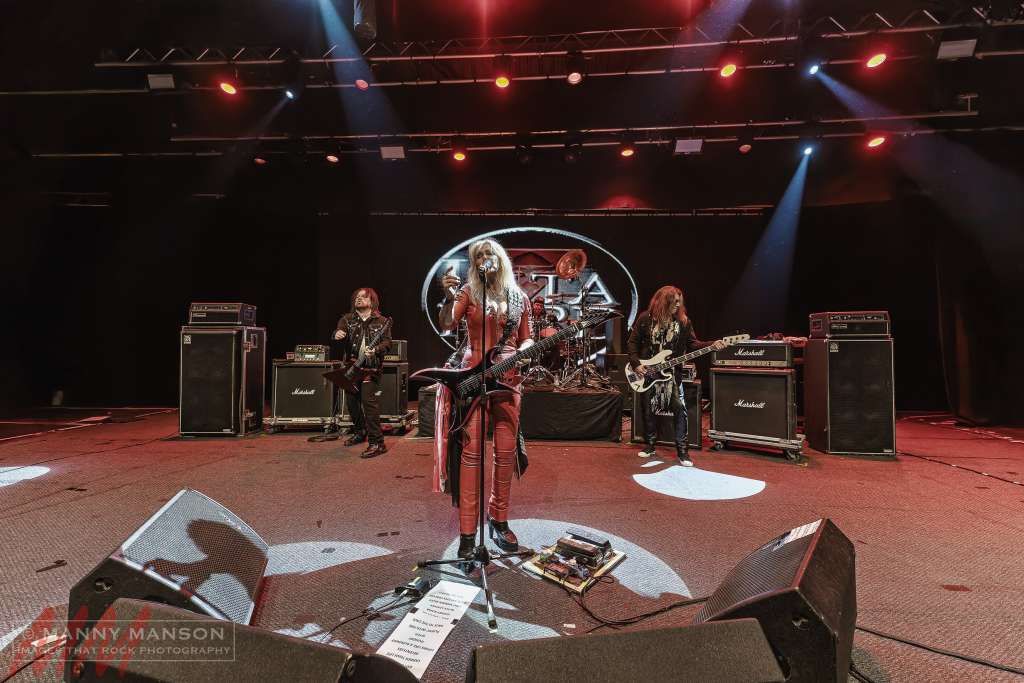
“Gotta Let Go” blew the doors off to start. Tight, snappy, bursting with that ’80s L.A. snarl she’s always done so well. “Larger Than Life” followed, groovy, chugging riff, dripping attitude, and then “Relentless,” with its machine-like tempo and sneering vocal. Her tone was razor-sharp, that signature guitar snarling through the mix. “Living Like a Runaway,” title track of her 2012 comeback record, was explosive, anthemic, confessional, loud as hell, and proud of it.
She’s not mellowed. If anything, she’s doubled down on the ferocity. “Hungry” was raw and punchy. Then came the inspired Elton John cover, “The Bitch Is Back,” which fit her too perfectly. She didn’t just cover it. She owned it. “Playing with Fire” turned the tempo up again. “Back to the Cave” was slow, sultry, bluesy in parts, with Lita letting those thick bends and slippery riffs do all the talking.

“Can’t Catch Me,” co-written with Lemmy back in the day, was a skull-crusher, all Motörhead-fuelled aggression and divebombs. Then the moment we were all waiting for, “Cherry Bomb.” She shouted, “You know this one!” and out struts Vixen and Chez Cane, all grinning like the devil. The bands traded vocals, and guitars, the crowd screamed along to every word, the chorus ricocheted off the walls. It was pure Runaways magic.
…She moved into what was originally titled “Black Leather”—her snarling take on the Sex Pistols tune from their 1978 sessions, which she famously recorded on her debut Out for Blood (1983), spiky, spiteful, drenched in punk venom, and delivered with the kind of unapologetic grit only she can muster.
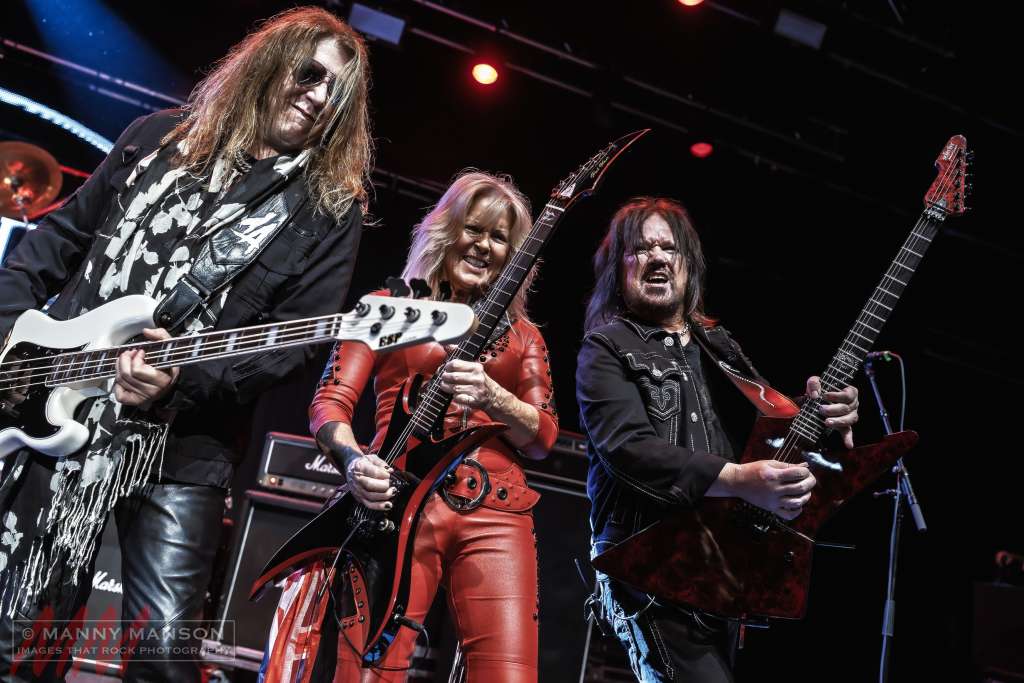
Then things softened, shifting tone and atmosphere with “Only Women Bleed.” Lita chose to interpret Alice Cooper’s 1975 Welcome to My Nightmare classic not as a sentimental dedication, but as a bold reclamation. She didn’t veil it in romanticism, she delivered it with raw respect. Her vocals were soft when needed, then fiercely intense as the chorus rose, giving the song fresh emotional resonance through a woman’s perspective on pain and strength. There were no theatrics, just her voice, steady, tempered, and powerful. It felt like a statement in vulnerability and power, delivered entirely through performance.
But then…..time stood still.

A hush fell over KK’s Steel Mill. Whispers turned to silence. Phones raised, lights glowing, eyes wide, breath held. Then on the screen behind Lita appeared a grainy still image of her cradled in Ozzy Osbourne’s arms, intimate and iconic, a memory frozen in time. The stage lights dimmed, fog wafted, and she stepped forward, dressed in that unforgettable red catsuit, the Black Widow hourglass emblazoned on it, wielding her white double‑neck B.C. Rich guitar like a ceremonial sceptre. The silence wasn’t emptiness, it was reverence.
When the first chords of “Close My Eyes Forever” drifted out, the crowd hushed entirely. Fans held their phones up like candles in a church. You could hear a pin drop. Written by Lita Ford and the late Ozzy Osbourne, recorded in 1987, released as a single in 1989 and peaking at No. 8 on the US Billboard Hot 100, that duet was both rock ballad and reclamation, an accidental lyric-writing session born out of intoxicated studio days that crystallised into one of their biggest hits.
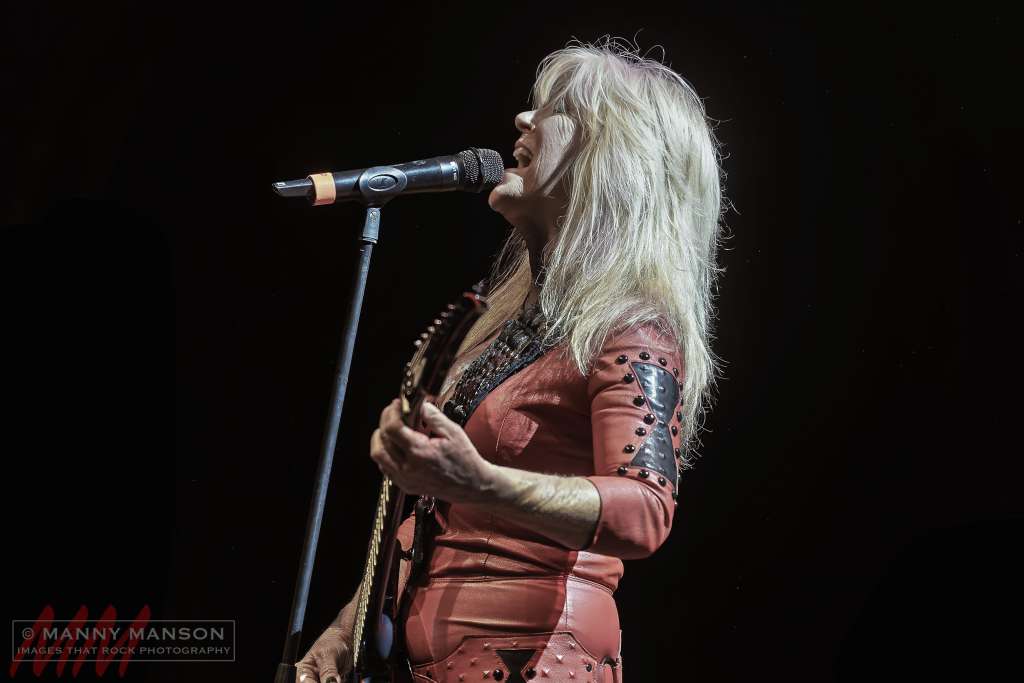
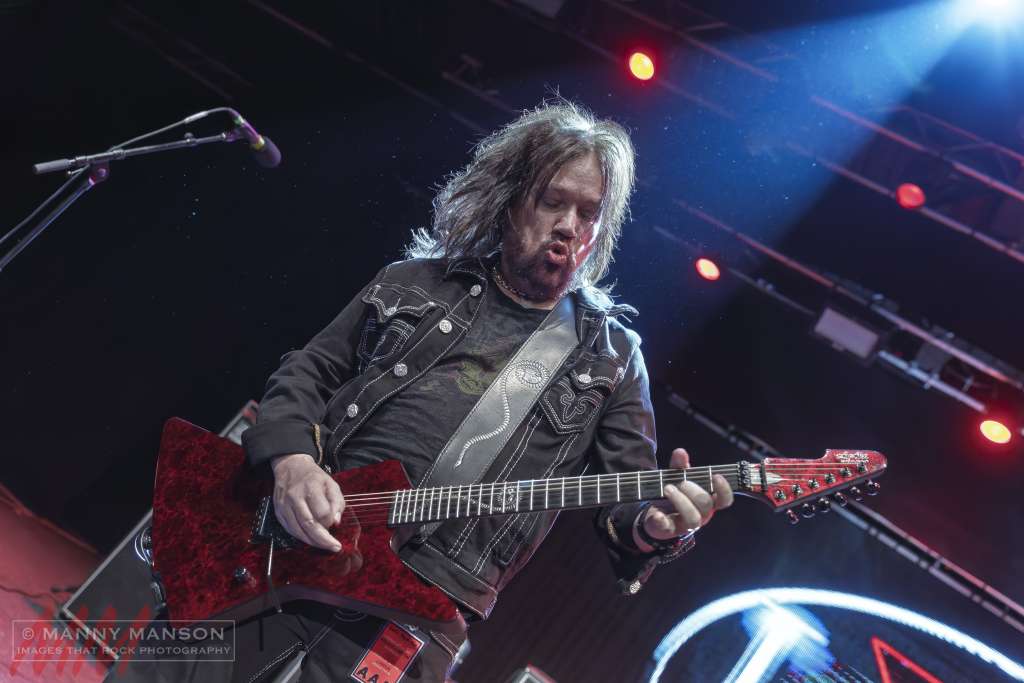
But tonight’s rendition had more than emotion, it had gravitas. The man at Lita’s side wasn’t Ozzy, of course, the crowd recognised Patrick Kennison, her longtime lead guitarist since 2014, playing the dark, melodic solo lines, letting the band weave around her voice with precision and tenderness. His fingers stroked the strings gently, echoing the ache of each lyric: “But I’m everywhere … just close my eyes forever.”
Lita’s voice started low, mournful, impossibly clear. Then the chorus rose, harmony backing swelling, weaving like smoke. She closed her eyes, singing not at us but through us—holding space, honouring memory. The backdrop image remained static and haunting, of a young OZZY, arms wrapped around a younger, spikey haired LITA. Phones flickered, catching glints of tears in eyes, heads bowed. The band stayed silent behind her, knitted into the drama, each note measured, each pick stroke reverent.
The power of that moment was overwhelming. It wasn’t showmanship—it was homage, sorrow, tribute, and love, all at once. When the final note faded into silence, it felt infinite. She lowered her guitar softly, took a breath, and only then did applause swell, cautious at first, then almost unstoppable.
Then Lita lifted her chin, looked across the room as if to say, “We remember. We carry on.” She nodded slowly. A beat. And then she slammed into one last anthem.

Kiss Me Deadly detonated. The room erupted. That razor-sharp riff, that spoken intro, “I went to a party last Saturday night…,” sounded not just like a song but a battle cry, and boom, we were all teenagers again, jumping, screaming, clapping along like it was the first time. Phones dropped to the side. Everyone moved. Everyone sang along. The KK’s Steel Mill had been transformed into a roar, a pulse, a cathedral of rebel youth.
She finished strong, searing that final chorus into memory. Then held her guitar aloft, guns‑up salute, spotlight crowned her. The curtains closed. The backdrop changed one last time, archive photos, vintage neon, atmosphere and strobes, and the band left not with a tip of the hat but with a statement: Red leather. Black widow. Screaming guitars. Flashbacks. Fireworks. Sweat and mascara. The avatar of rebellion. Ghosts and angels swirling in her wake.
When the house lights finally flicked up, it felt more like permission to breathe again. We spilled out into the Wolverhampton night, ringing with sound and sweat, mascara melting on many, hearts pounding. We’d just been baptised in rock history: Chez Kane ‘s neon glam fury, Vixen ‘s legacy reincarnated, and Lita Ford ‘s original Black Widow fire, live and unapologetic.

This was a blazing tribute to survival, reinvention, and unapologetic female power in rock. I drove home safe from the tinnitus in my ear, call me soft but ear plugs really help, and a grin that suggested I’d witnessed something untouchable. Wolverhampton might have survived the night. But That, my friends, was Girls Night Out, and what a night!