Review by Rick Eaglestone for MPM
Devin Townsend does not make small promises. Over the course of a career that has stretched across four decades, nearly thirty studio records, multiple bands, and more genre permutations than most musicians accumulate in several lifetimes, he has built a reputation for ambition that occasionally borders on the reckless.
But nothing — not Ziltoid the Omniscient, not Empath, not Synchestra in all its bewildering glory — has ever been positioned quite like The Moth. This is the record Townsend has described as his life’s work. The thing he could not stop thinking about. The project that first took shape in his mind over a decade ago and refused, no matter how many other albums he made in the interim, to go away.
When something has been promised for that long, the expectations become almost impossible to manage. A decade’s worth of hype has a way of calcifying into a burden that even the most gifted artist might buckle under. And then The Moth arrives — twenty-four tracks, recorded across more than ten countries, featuring an orchestra and choir from the Netherlands, Steve Vai, Anneke Van Giersbergen, long-standing collaborators Mike Keneally, Darby Todd and James Leach, vocalist Lynn Wu, and literally hundreds of musicians, engineers, and creative contributors — and the first thing you feel is not relief that it lives up to the hype. It’s something closer to awe that one person’s vision could be realised at this scale at all.
The concept at the heart of The Moth is deceptively straightforward. Townsend has described it as a loose narrative following someone who comes to understand that old patterns of behaviour no longer serve them. The moth itself is the central metaphor: the transformation from caterpillar to something entirely different, a creature so drawn to the light that it burns itself to reach it. Self-acceptance. Surrender. The terrifying, necessary courage to sit with discomfort rather than run from it. These are not new themes for Townsend — the tension between chaos and peace has animated his work for most of his career — but here they are given a canvas proportional to their weight. And the result is, without question, the most emotionally complete and sonically monumental thing he has ever made.
Albums that open with a prologue are making a statement. The Moth earns it. “Semi-Prologue” establishes the emotional register of the whole record in under two minutes: intimate, a little unsettling, and with an orchestral undertow that suggests something vast is about to move beneath the surface. It is not a showstopper. It is not trying to be. It is a door opening into a world that has been meticulously constructed, and it does its job with the quiet authority of something that knows exactly what it is doing. The album’s proper opening salvo lands with genuine force. “War Beyond Words” is The Moth at its most nakedly progressive, a track that shifts beneath your feet like tectonic plates in slow motion. The orchestral weight here is enormous — Jukka Iisakkila’s conducting of the Noord Nederlands Orkest lends every swell and surge a grandeur that studio trickery simply cannot fake. Townsend’s voice is already giving everything. This is a man who has spent decades learning how to communicate in volume and frequency, and from the first real moment of The Moth, he is doing exactly that.
The title track is not the centrepiece you might expect — it is something more personal than that. Where “War Beyond Words” is declaration, “The Moth” is confession. The metaphor of the creature drawn helplessly toward the light it knows will destroy it is handled with a gentleness that catches you off guard after the opening assault. Choir and orchestra breathe together underneath Townsend’s vocals, and the effect is one of suspension — as though the record has paused to take stock of exactly how far it is willing to go. The answer, it quickly becomes apparent, is all the way.
One of The Moth’s most immediately striking moments, “Ode to My Eye” has a melodic core that reaches back toward the warm, accessible side of Townsend’s catalogue — the part of him that gave the world Addicted! and Casualties of Cool. But it is expanded here, given orchestral architecture and choral depth that transform it into something considerably more than a song. Darby Todd’s drumming is worth singling out for praise throughout the record, but here in particular he provides a rhythmic foundation so assured that the most theatrical moments feel grounded and earned.
Released as the lead single and the world’s first real encounter with The Moth, “Enter the City” remains one of the record’s most electrifying moments in context. The choir arrives like a wall of chanting menace before Townsend’s riffs hit with the force of a controlled demolition. Mike Keneally’s guitar work here is spectacular — his years with Frank Zappa have given him an improvisational intelligence that slots perfectly into Townsend’s universe of organised chaos. The track escalates with a kind of furious momentum that feels almost cinematic, and by the time it peaks you understand precisely what the album is going to demand of you.
A moment of relative stillness after the exhilaration of “Enter the City,” “Covered by Causes” is where The Moth’s narrative begins to develop its interior life. The orchestration here is more contemplative, the dynamics more carefully managed, and Townsend’s vocal delivery shifts into a register that feels genuinely reflective rather than declarative. It is the kind of track that rewards the listener who approaches The Moth as a complete work rather than a collection of moments — patient, purposeful, and quietly devastating.
One of the most discussed tracks in the album’s early coverage, “Lexin” introduces a character that functions almost as a guide figure within the album’s narrative world. Anneke Van Giersbergen is, frankly, breathtaking throughout The Moth, but here she is given space to define a presence that feels genuinely mythological. The section builds with an urgency and a warmth that is distinctly her — few vocalists anywhere in this genre have her ability to hold melody and emotion simultaneously, and alongside Townsend’s production instincts, the result is extraordinary. If this is indeed a nod to the Childlike Empress at the heart of The Neverending Story, as some fans have speculated, it is one of the most elegant Easter eggs in recent prog memory.
A propulsive, kinetic track that recalls the more accessible end of the Devin Townsend Project era, “Runaways” provides one of The Moth’s most immediately gratifying rushes. James Leach’s bass is particularly prominent here — his work in Sikth gave him a feel for the way rhythm can be both anchor and destabilising force simultaneously, and he brings that duality to bear throughout the record. “Runaways” is the track you suspect will become a live favourite when — or if — Townsend eventually decides to bring this project to the stage.
One of the album’s more imposing centrepieces, “A Proxy for God” puts the Noord Nederlands Orkest at full force and does not apologise for a single note of it. This is The Moth at its most theatrically ambitious — the scale is operatic, the dynamics sweeping from near-silence to something that sounds like the sky falling in. Townsend has always had a complicated relationship with the concept of God, and this track sits squarely in that tradition: questioning, awed, furious, and oddly moving all at once. By any measure, it is one of the album’s defining moments.
Among the most emotionally direct tracks on the record, “The Mothers” carries a tenderness that recontextualises everything around it. Lynn Wu’s vocal contributions here are genuinely affecting, her voice threading through the arrangement with a lightness that offsets the orchestral density elsewhere. The album’s themes of acceptance and transformation find their most human expression in moments like this one, and it is a mark of Townsend’s maturity as a composer that the grandeur never crowds out the intimacy.
A personal favourite for many who have spent time with advance material, “Orion” is the kind of track you find yourself returning to before you have fully processed why. There is a cosmic quality to its construction — Townsend has always had an ear for the infinite, and here the orchestra and choir are deployed not as spectacle but as atmosphere, generating a sense of scale that feels earned rather than imposed. It moves through several emotional registers without losing its coherence, and by its end you are somewhere quite different from where you started.
A track that arrives like a moment of rest in the middle of a long journey, “Stay There” is The Moth in its most nakedly pleading mode. The orchestration is stripped back, the drama quieted, and what remains is something that sounds remarkably like a man asking himself — or asking someone, anyone — to simply not leave. Given the record’s broader themes of transformation and self-acceptance, it lands with a particular ache. Not every track on a 24-song album needs to aim for the top of the mountain. Some of them need to sit very still at its foot and breathe.
Released as the album’s second single, “Home at Night” is one of The Moth’s most quietly devastating pieces, and one of Townsend’s most personally candid. Written during the difficulty of being away from home while his family were there, it carries that specific exhaustion that comes from loving people you keep leaving. The production here is beautiful in its restraint — warm, close, unhurried — and the orchestral swell that carries the track toward its conclusion feels less like production and more like memory. Anyone who has missed home in the way only long-distance touring musicians know will not hear this one without feeling something real.
Exactly what the name suggests, and all the better for committing to it fully. A brief orchestral interlude that reorients the listener before the album’s second half begins in earnest, “Intermission” is not attempting to be a track in the conventional sense. It is a breath, a hinge, a moment for the music to gather itself. Given the weight of what has come before and what is about to follow, it is entirely necessary.
The return of the album’s central narrative figure brings with it a shift in emotional temperature. Where the first “Lexin” was introduction and mystery, “Lexin Returns” is revelation and reckoning. Van Giersbergen delivers another performance of remarkable emotional precision, and the orchestral and choral elements are woven around her with a complexity that rewards close listening. This is one of the record’s most rewarding stretches, a section that demonstrates how thoroughly Townsend has thought through the architecture of this album as a narrative rather than a sequence of songs.
Dark, imposing, and built around a rhythm that has the weight of inevitability, “The Clergy” is one of The Moth’s more unsettling moments. The choir is deployed to extraordinary effect here — less as uplift and more as institutional pressure, a wall of voices that feels as much like judgement as it does like music. Todd’s drumming drives the track with a controlled ferocity, and Keneally’s guitar finds the kind of melodic angles that make the heaviest passages feel intelligent rather than merely brutal. A genuinely striking piece of work.
Released as a double single and best experienced as a single continuous piece, these two tracks together represent The Moth at its most viscerally exciting. “Prepare for War” builds with the momentum of something enormous gathering itself, and “The Big Snit” releases that tension in a surge of orchestrated chaos that is, frankly, one of the most thrilling three minutes this reviewer has spent with a record in recent memory. The orchestral elements have a massive footprint here, and Townsend’s vocals are at their most incensed — screaming into the arrangement with a conviction that makes the technical achievement feel incidental to the emotional one.
The track that marks the album’s central transformation — the moment where the caterpillar gives way to the moth. What arrives after the fury of “The Big Snit” is something genuinely different in register: open, luminous, and marked by a sense of arrival that the album has been earning across its preceding eighteen tracks. Steve Vai’s presence on the record, rooted in the history he and Townsend share from the Sex & Religion sessions back in 1993, adds a dimension that no other guitarist could. “Silver Princess” is where that chemistry finds its most affecting expression.
Townsend has always had a gift for the kind of emotional retrospection that sounds less like self-pity and more like genuine reckoning, and “A Life in Review” is perhaps the purest expression of that gift in his entire catalogue. This is a man looking back across thirty years of music-making, across the chaos and the creativity and the cost, and finding something that resembles peace with what he sees. The orchestration here is as complex as anywhere on the record, but the effect is of clarity rather than density. Quietly extraordinary.
The transformation is complete, and “Metamorphosis” names it directly. By this point in The Moth, the listener has been thoroughly taken apart and put back together by the sheer accumulated weight of the album’s ambition and emotional honesty, and this track arrives as both confirmation and celebration of that process. The choir is resplendent, the orchestra fully unfurled, and Townsend’s production — a career’s worth of lessons in how to make enormity feel personal — is at its most consummate.
A late-album meditation that carries the bruised wisdom of everything that has preceded it, “Stained Hearts” is — like so much of the record’s second half — best described as evidence that Devin Townsend has never been more honest, or more generous, as a songwriter. The intimacy here is striking after the scale of “Metamorphosis,” and it works precisely because the album has earned the right to sit quietly without losing any of its weight.
The title is the message. After twenty-two tracks of holding on — to patterns, to fear, to old versions of the self that no longer serve — “Let Go” asks for exactly that and does so with a gentleness and a grace that land harder than any of the record’s more spectacular gestures. Van Giersbergen and Wu are both present here, and the interplay of their voices with Townsend’s around an orchestral arrangement of genuine beauty is one of The Moth’s most affecting moments. A song that understands what it means to finally put something down.
And then Devin Townsend closes the most ambitious album of his career with a song about dogs. If you have spent any time with the man’s work — or with his social media, or with any interview he has given in the last decade — this will surprise you not even slightly. It is funny, it is warm, it is genuinely moving in the way that only things that do not try to be moving ever are, and it is the perfect ending to a record that might otherwise collapse under its own weight. After everything, The Moth has asked of its listener, after all the transformation and reckoning and orchestral grandeur, the last thing it says is dogs are good and we do not deserve them. Reader, it works.
There will be those who approach The Moth looking for the tight, focused album that a decade’s anticipation demands. They will find instead something much messier, much more human, and considerably more honest: a record that wears its ambition and its vulnerability in equal measure, which does not always succeed with perfect grace, and that is all the more extraordinary for it. Townsend has never been a musician who trades in safety, and The Moth is the least safe thing he has ever done. It is a 24-track, multi-orchestral, globally recorded conceptual behemoth that tries to articulate what it means to change, to accept yourself, to let old patterns die and allow something new to take their place. And it very nearly pulls all of it off completely.
What will stay with you after The Moth is not any single track or moment, though there are many of both worth returning to. What stays is the cumulative effect: the sense of having spent just under two hours with someone who has been genuinely honest about what they needed to say, and who assembled everything they had learned across a career of extraordinary range and productivity in order to say it. The Noord Nederlands Orkest and Choir are magnificent throughout. Keneally, Todd, and Leach bring decades of shared language to a record that clearly needed them. Van Giersbergen and Wu are, without qualification, two of the finest vocalists working in this or any adjacent genre. And Steve Vai, returning to the collaboration that launched Townsend’s career over thirty years ago, adds a dimension that closes a circle the man himself has been quietly describing for his entire professional life.
Devin Townsend announced an indefinite hiatus from touring as this album was completed. Whether that means The Moth is a farewell or simply a pause, it deserves to be heard as what it is: a record made by someone who needed to make it, who took as long as it needed, who refused to compromise on its scope or its honesty, and who finished it. In a landscape full of albums that aim for the grand and arrive at the merely large, The Moth is the genuine article.
Highest possible recommendation. Put the headphones on, block out two hours, and let it take you.
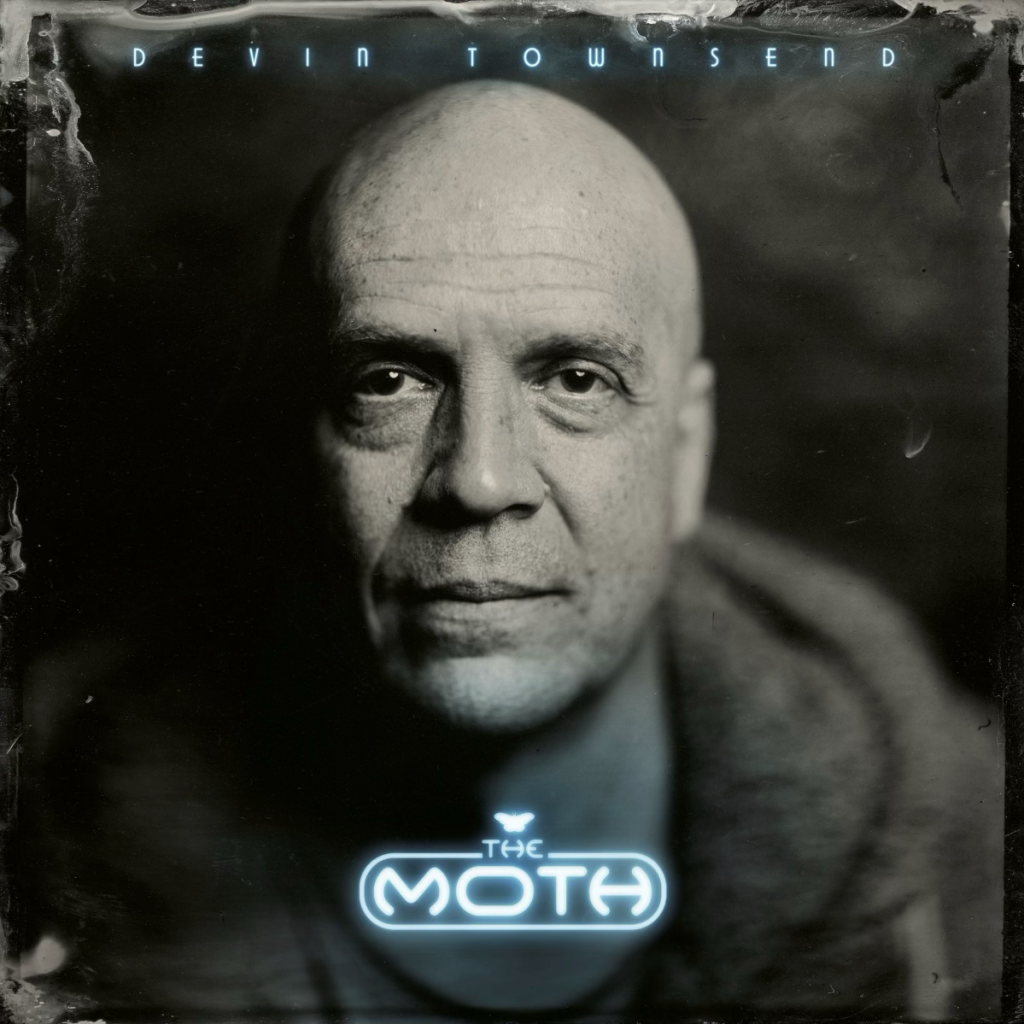
The Moth Track listing:
01. Semi-Prologue
02. War Beyond Words
03. The Moth
04. Ode to My Eye
05. Enter the City
06. Covered by Causes
07. Lexin
08. Runaways
09. A Proxy for God
10. The Mothers
11. Orion
12. Stay There
13. Home at Night
14. Intermission
15. Lexin Returns
16. The Clergy
17. Prepare for War
18. The Big Snit
19. Silver Princess
20. A Life in Review
21. Metamorphosis
22. Stained Hearts
23. Let Go
24. We Don’t Deserve Dogs
Line-up:
Devin Townsend – Lead Vocals, Guitars
Darby Todd – Drums
Mike Keneally – Guitars
James Leach – Bass Guitar
Anneke Van Giersbergen – Lead & Backing Vocals
Lynn Wu – Lead & Backing Vocals
Steve Vai – Guest Guitar
Aman Kohsla – Acoustic Guitar
Noord Nederlands Orkest – Orchestra
Noord Nederlands Koor – Choir
Jukka Iisakkila – Conductor
Website: www.devintownsend.com
Spotify: https://open.spotify.com/artist/6uejjWIOshliv2Ho0OJAQN
Instagram: www.instagram.com/dvntownsend
Facebook: www.facebook.com/dvntownsend
X: x.com/dvntownsend
10/10 A masterwork. Career-defining.