
Review by Rick Eaglestone for MPM
Every diptych lives or dies on its second half. Chapter one lands the blow; chapter two has to prove the blow meant something. When Marilyn Manson released One Assassination Under God – Chapter 1 back in November 2024, he pulled off the improbable and turned the lowest, most contested stretch of his career into a comeback record, a gothic-industrial reckoning dropped, with characteristic provocation and now, some twenty months on, Chapter 2 arrives to close the circle.
Chapter 1 was the sound of an artist who had been dropped by his label, his agency, and his management in 2021 after allegations of abuse, allegations he has consistently denied. The first record made the media firestorm its explicit subject; the second picks up precisely where that left off, less interested in mounting a defence than in planting a flag.
Once again Manson has written and produced the whole thing hand in glove with Tyler Bates, the film-score composer whose partnership with him now spans four albums starting with The Pale Emperor in 2015, Heaven Upside Down in 2017 and Chapter 1 before this one. Bates is the single biggest reason this late-career run sounds the way it does: cinematic, patient, built on atmosphere and dynamics as much as on riffs, a world away from the digital bludgeon of the Skold-era industrial records or the arena gloss that crept in during the mid-2000s. If Chapter 1 re-established that voice, Chapter 2 sets about refining it.
On the evidence, it is a good deal more than a bag of offcuts, though it never quite escapes the shadow of the record it mirrors. Even the closing track tips the concept’s hand before you’ve heard a note of it: “Enantiomorph” is a word for a pair of mirror-image forms, the left and right hands of the same underlying shape. That is exactly what this album sets out to be in relation to Chapter 1 – not so much a sequel that advances the plot as a reflection of it, the same face studied from the opposite side. Whether that makes Chapter 2 essential or merely elegant is the whole question, and it is worth walking the record track by track before handing down a verdict.
Unalive throws the doors open without ceremony. Where Chapter 1 eased you in across the five-and-a-half brooding minutes of its title track, letting the dread build by increments, this gets straight to the sneer. The title itself is loaded – lifted from the euphemistic, algorithm-dodging dialect of the modern internet – and Manson being Manson, he turns that borrowed squeamishness into a weapon, daring you to flinch at a word invented precisely so nobody has to. Musically it’s a taut, pulsing industrial opener, Bates’s programming locked to a grinding low-end while the guitars snap in and out of the frame. It is a statement of intent: Chapter 2 intends to prod rather than seduce, and it wastes very little time telling you so. If the first record opened like a slow-tightening noose, this one opens with a shove.
Don’t Answer The Door leans hard into Bates’s horror-scoring instincts, and it is one of the album’s more atmospheric successes. The title alone does half the work, conjuring the oldest dread in the book the thing on the other side of the wood – and the arrangement earns it, creeping in on a low, patient menace before the chorus lands with real weight. This is the strain of Manson that the Bates partnership has always flattered: unhurried, cinematic, more interested in tension than in tempo. Set against the front-loaded aggression of Chapter 1’s early run, it shows a record willing to withhold, to let the discomfort do the heavy lifting. It won’t be the track anyone reaches for first, but it’s the kind of deep cut that rewards the dark and the volume, and it quietly makes the case that the second chapter has moods the first one didn’t bother to explore.
Front Toward Enemy has the most interesting history of anything here. The song first surfaced back in 2024 as a B-side tucked onto the “Raise the Red Flag” single during the Chapter 1 campaign, so its promotion to a fully-fledged Chapter 2 single is itself a statement about the two records being one continuous body of work rather than two separate releases. Fittingly, it’s the most straightforwardly aggressive thing on the album: a pounding, fist-swinging industrial number whose title borrows the ordnance language stamped on a Claymore mine, and whose lyric is essentially a rallying cry to get up off the floor and fight. There is a direct line from here back to “Raise the Red Flag” and its finger-pointing defiance the same posture, the same refusal to back down but this is blunter, meaner, and built for a live crowd. Subtle it is not; a genuine adrenaline hit it absolutely is, and in sequence it snaps the record’s head back at just the right moment.
All The Vilest Things is where the “same recipe” worry bites hardest, and it will divide the faithful. The title is pure Manson melodrama, and the track leans all the way into the goth-glam theatre that has always been a part of his arsenal – the pantomime end of the spectrum, all swagger and gothic camp. If Chapter 1 had “Sacrilegious,” its glam-pop calling card, then this is that same instinct pushed a step further towards spectacle, and whether it reads as a gleeful strut or as self-parody will depend entirely on how much rope you’re prepared to hand him. I land somewhere in the middle: the hook is undeniably sticky, but there’s a whiff of Manson-by-numbers about the whole thing, the sound of a formula being reliably executed rather than a song clawing for something new. It is the moment the album most sounds like a reflection of a better original.
None of the Suns provides the mid-album exhale, and it is a smart bit of sequencing. After the swagger of the two tracks before it, this is the record widening its emotional palette, more melodic, more atmospheric, built around Manson’s cleaner register rather than his snarl. The wordplay in the title (suns for sons) is the kind of loaded double meaning he’s traded in for thirty years, and Bates frames it with a restraint that lets the melody breathe. It is the Chapter 2 equivalent of the quieter, more affecting corners of the first record, the moments where the theatre drops away and something more human shows through. Not everyone will have the patience for it, and it doesn’t detonate the way the singles do, but it’s proof that this pairing can still write for the heart as well as the sneer, and the album is better for the change of light.
Lucifer’s Teardrop swings the weight back towards the guitars, and it lands like a course-correction after the mid-album lull. This is one of the record’s heaviest cuts, a grinding, groove-driven thing built on the sort of industrial-metal muscle that powered “Raise the Red Flag” two years ago and the title is exactly the kind of blasphemous flourish Manson can still toss off in his sleep. What lifts it above provocation-for-its-own-sake is the arrangement: Bates keeps the low end physical and the atmosphere thick, so the heaviness feels earned rather than bolted on. It’s a reminder that underneath the concept and the controversy this remains, when it wants to be, a genuinely heavy record, and it re-establishes the momentum that carries the back half. Play it next to the muscle of Chapter 1 and you can hear a band comfortable in its own weight, no longer proving it can still hit hard, simply doing it.
The Arsonist is one of the album’s stronger deep cuts, a slow-burning creep of a track that gets thoroughly under the skin. There is a patience to the build that pays off, and the imagery of destruction and self-immolation sits squarely inside the record’s wider rhetoric of damage repurposed as fuel, of wounds turned into weapons. It’s Manson in his element as a storyteller: the arsonist as a figure who burns everything down and stands warming his hands in the wreckage. Where a lesser track here settles for atmosphere, this one uses it, ratcheting the unease until the release feels like a payoff rather than a formality. It’s the sort of cut that would have slotted comfortably onto Chapter 1 and, tellingly, wouldn’t have been out of place among its highlights – which is about the highest compliment a second-chapter deep cut can be paid.
Exit Wound is the one that did the early damage. Released as the lead single is the record’s most immediate, most replayable moment – a strutting, glammed-up goth-rocker with a hook that burrows in and refuses to leave, the kind of thing that lodges in your skull on first listen and tells you exactly why it was chosen to reintroduce the project. The lyric trades in the album’s recurring imagery of a staged crime scene and a verdict decided before any evidence is heard, Manson casting himself, predictably but effectively, as the man in the frame. Its accompanying video did double duty, quietly reintroducing the returned Tim Skold to the fold. In the Chapter 1 to Chapter 2 conversation, this is the direct descendant of “Sacrilegious” the sleek, pop-literate single that does the heavy commercial lifting – and on pure craft it is the best song here. If any track on Chapter 2 escapes the shadow of its predecessor and simply stands on its own, it’s this one.
Enantiomorph closes the record and, in true Manson fashion, saves a moment of real ambition for last. It opens on a bed of samples that act as a scene-setting intro before a hushed, piano-led section takes hold, building degree by degree into the most nakedly emotional stretch on the record – Manson turning the lens inward on the bleakest parts of himself. It is the most structurally daring thing on the album, and its purpose is unmistakable once you clock the title: a mirror image, deliberately echoing the slow-burning, brooding shape of Chapter 1’s title-track opener. The first record opened with that patient, dread-soaked crawl; the second closes on its reflection, the diptych folding shut on itself. As closers go it is genuinely affecting, cinematic and controlled, and it sends the album out not on a snarl but on something closer to catharsis. It is the clearest single piece of evidence that Chapter 2 was conceived as one half of a whole rather than a hasty follow-up, and it lingers.
What holds all this together, as it did on Chapter 1, is Bates. His fingerprints are on every frame, the low-lit, widescreen sound, the willingness to let a song breathe rather than sprint, the sense of a film composer scoring the interior life of a man who has spent five years being talked about. It occasionally tips into indulgence; there are stretches where you find yourself wanting a track to simply plant its feet and hit, rather than smoulder for another thirty seconds. But the record is at its best precisely when Bates leans into dread and dynamics instead of straight aggression, and across nine tracks that instinct wins out more often than not. Where Chapter 1 carried the electric charge of a return nobody was sure would happen, Chapter 2 trades that novelty for craft, and craft, it turns out, is the thing this partnership has in abundance.
So which chapter wins? For my money, Chapter 1 still has the better story and the higher peaks. “As Sick as the Secrets Within,” that brooding title track and the defiant charge of “Raise the Red Flag” gave it a spine of legitimately strong singles and the crackle of a man with everything to prove and nothing left to lose. Chapter 2 is smoother, more assured, arguably more consistent from track to track there is less filler and fewer missteps, but it lacks the jeopardy that made the first record so magnetic. This is the sound of an artist who has already made his comeback and is now furnishing the house he fought to keep. That is not a criticism, exactly; consistency has its own quiet value, and plenty of long-running acts would kill for a late run this coherent.
Two records, one story, told by a man utterly determined to have the final word on his own myth. Whether that last word lands for you as triumph, as provocation or as a shrug will depend entirely on what you carried in with you – no review can, or should, decide that. But purely as a piece of craft, Chapter 2 closes the book with more control and more coherence than most artists in his position could dream of mustering. The story, such as it is, is finished. The mirror is complete.
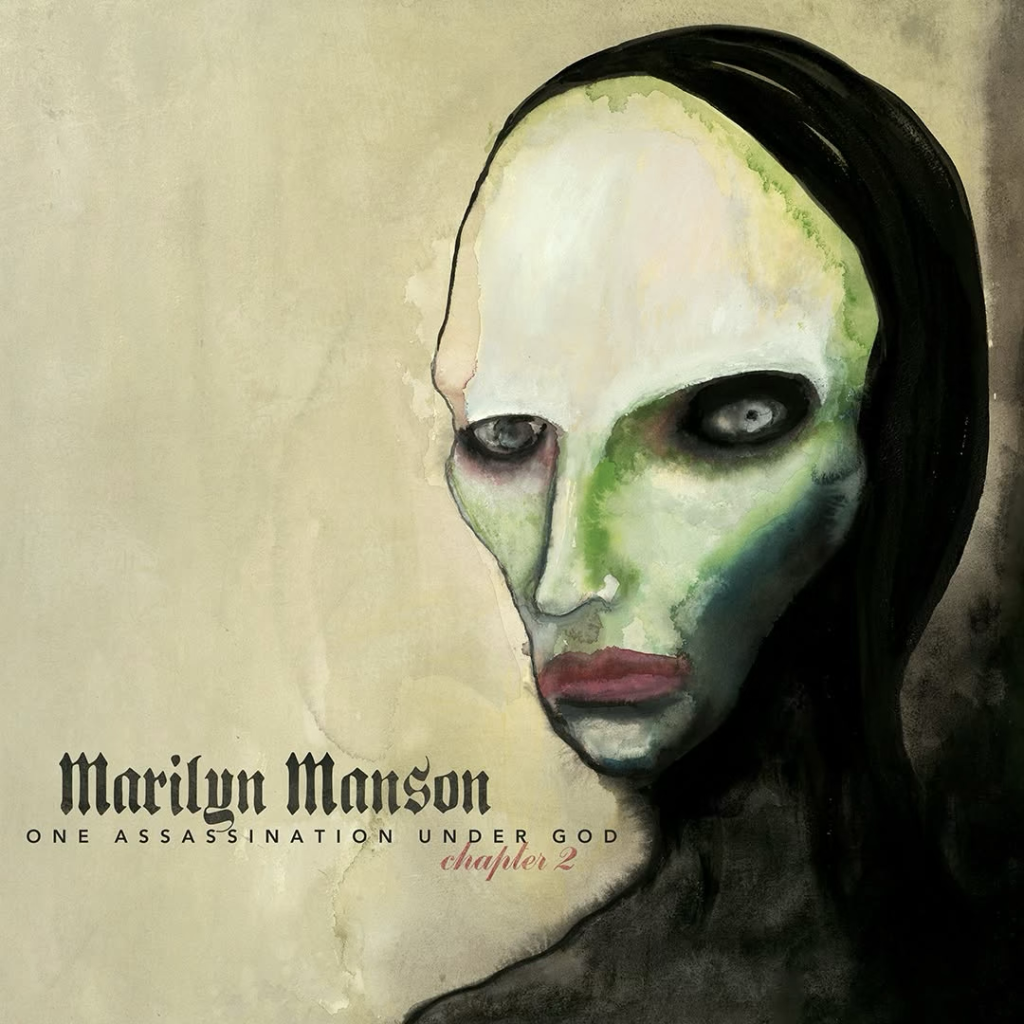
“I used each stone that was thrown at me to sharpen my edges.” – Marilyn Manson
One Assassination Under God – Chapter 2 – Track listing:
1. Unalive
2. Don’t Answer The Door
3. Front Toward Enemy
4. All The Vilest Things
5. None of the Suns
6. Lucifer’s Teardrop
7. The Arsonist
8. Exit Wound
9. Enantiomorph
Line-up:
Marilyn Manson – Vocals, songwriting
Tyler Bates – Instrumentation, songwriting, production
Current touring line-up:
Nick Annis – Guitar
Piggy D. – Guitar
Tim Skold – Bass
Spotify: https://open.spotify.com/artist/2VYQTNDsvvKN9wmU5W7xpj
Instagram: https://www.instagram.com/marilynmanson
Facebook: https://www.facebook.com/MarilynManson/
X: https://x.com/marilynmanson
9/10