Review by Rick Eaglestone
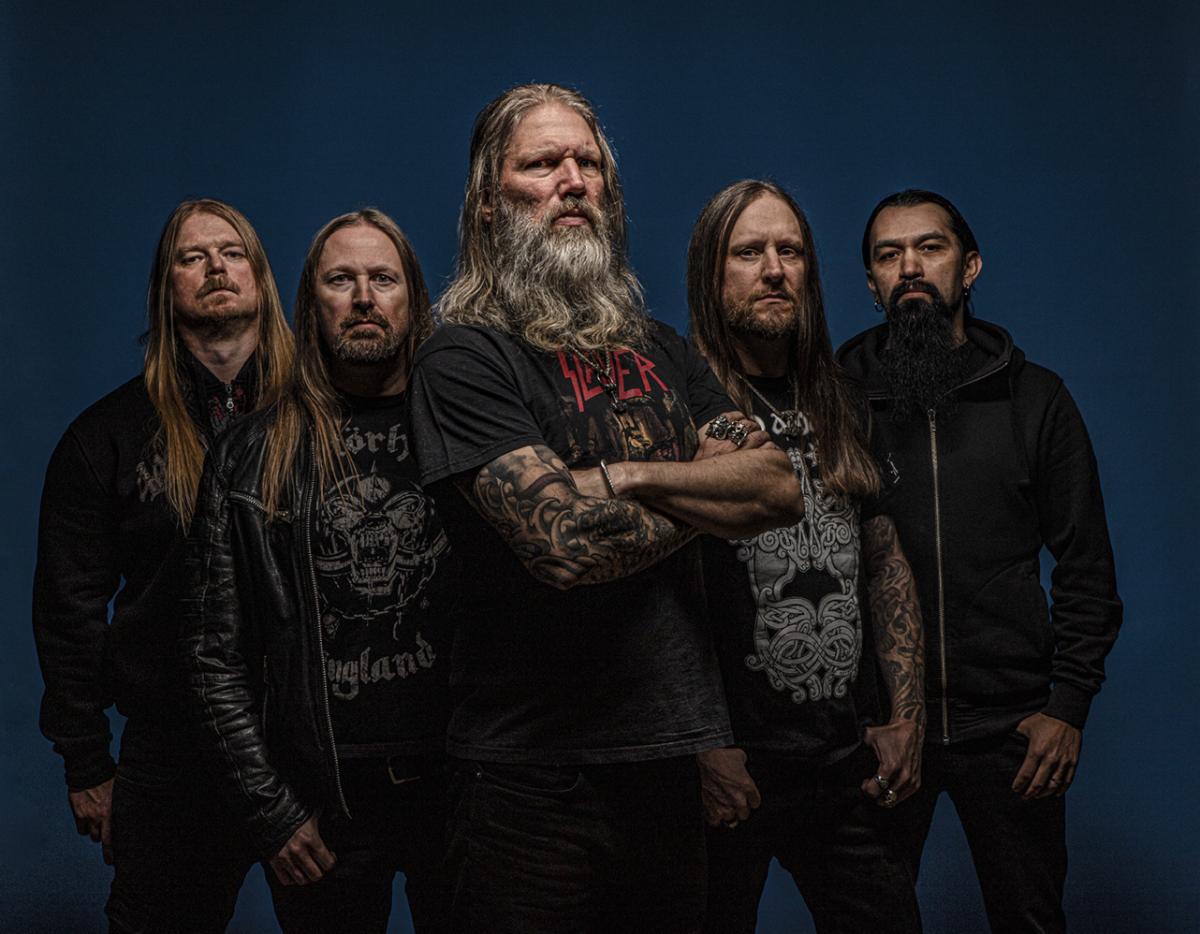
Thirteen albums in, and Amon Amarth still wake up every morning with Odin on the brain. That is not a complaint, or at least not entirely. Very few bands in heavy music have committed so completely to a single idea for so long, and fewer still have turned that commitment into an arena-conquering institution without the whole enterprise curdling into self-parody. The Tumba five-piece formed in 1992, issued Once Sent from the Golden Hall in 1998, and have spent the decades since honing a sound so distinctive you can clock it within two bars: harmonised twin-guitar melodies pitched somewhere between a battle hymn and a folk lament, a rhythm section as sturdy as a longship’s keel, and Johan Hegg delivering sagas in that unmistakable roar of gravel and mead. The Allfather Awakens, landing on 2 October through Metal Blade, is the thirteenth chapter of that saga, and it arrives with an unusual amount of ceremony. Four singles, the band’s first ever acoustic piece, a music video that relocates Norse myth to the American West, and an entirely new stage production modelled on Odin’s Golden Hall itself. The title reads like a statement of intent, and the band have clearly treated it as one. The Allfather has not merely stirred in his sleep. He is up, dressed, and in a mood to rally the troops.
The most interesting story here, though, is not the what but the how. For 2022’s The Great Heathen Army the band decamped to Derbyshire to work with Andy Sneap at his Backstage Productions studio. This time they headed to Denmark and the studio of Jacob Hansen and changed the way they go about making a record. The songs were written in the gaps between gigs rather than in one block once the touring was done, then tracked across two sessions months apart, the first in the spring of 2025 and the last in March 2026. More unusual still, each song was taken all the way to completion, drums, guitars, and vocals, before the band moved on to the next one. It is a working pattern that treats every song as a self-contained job rather than part of a batch, and it cuts both ways. Every track gets the band’s undivided focus, which on paper should mean fewer passengers and less filler; the flip side is that a record-built brick by brick can lack the cohesion and momentum of one captured in a single concentrated burst.
There is also a practical logic to writing on the road that is easy to overlook. Amon Amarth is, first and foremost, a live band, and their records have long been judged partly by how well the songs translate to a festival main stage at dusk. Composing between gigs, with the roar of the previous night’s crowd still ringing in their ears, means the songs are being shaped in the environment they are destined for. Music came first, with the lyrics written afterwards to match the mood each piece suggested, as is the band’s practice, but the pressure of the stage has never been so directly baked into the process.
There is a tonal shift to note too. Olavi Mikkonen and Johan Söderberg have abandoned their 5150 amplifiers and gone back to Marshalls, a deliberate step away from the tighter, more clinical crunch of recent years towards something warmer, rawer, and more classic. For a band, whose guitar harmonies are their signature, which is not a cosmetic change. It is the difference between a sword freshly forged and one that has seen a few winters, and on the evidence of the singles it suits them. Behind the kit, Jocke Wallgren, now well settled into the engine room alongside long-serving bassist Ted Lundström, gives the whole thing the propulsion it needs.
It is worth being clear about what The Allfather Awakens is not: it is not a concept album. Odin is the thread that binds everything together, as he has been across the entire Amon Amarth catalogue, but the ten songs stand alone, each pulling its subject from a different corner of the sagas or the history books, with no overarching storyline tying them together. Tellingly, The Allfather Awakes, the song that lent the record its title, was the very last one written, which suggests the album found its identity at the end of the process rather than the start. And given the working method, that makes a certain sense: a collection of individually crafted songs, only revealing what united them once the final piece clicked into place.
It also arrives at a moment when Amon Amarth’s cultural footprint has spread well beyond the metal faithful. The famous Row, fans sitting in the dirt and rowing an imaginary longship in unison, is generally agreed to have started during their 2009 set at Bloodstock, and this summer it turned up in the stands at the 2026 World Cup courtesy of Norway’s supporters. When a band’s gig ritual becomes a football chant on the world stage, they have stopped being a cult concern. The question hanging over any Amon Amarth album at this stage is not whether it will be competent, because it will. It is whether a band this established, this beloved and this consistent can still find something new to say without breaking what their audience loves. On that front, The Allfather Awakens is at least asking the right questions.
Gjallarhorn opens the record and was its lead single, and it wastes no time. In the myths, Gjallarhorn is the horn Heimdall will sound to announce Ragnarök, but in Snorri’s telling it is also the vessel Mímir drinks from at his well, the same well into which Oden cast his eye as the price of knowledge no one else could claim. It is that sacrifice the band hang the song upon, and musically it is Amon Amarth with the throttle wide open, brisk and bright-sounding and built around a hook meant for thousands of voices, with enough twists in the arrangement to stop it ever feeling like autopilot. As an opening statement it is exactly what you would want, a reminder that for all the new methods, the fundamentals remain firmly intact.
Eight Legs of Thunder was the last of the four previews and is the most gleefully literal song on the record. It is about Sleipnir, Oden’s eight-legged steed, so naturally it is built on a galloping riff, the sort that has been a staple of heavy metal ever since a certain East London band first put the spurs in. The refrain is pitched squarely at the back of the arena, and the accompanying video, directed by Dariusz Szermanowicz, is a genuine curveball: it swaps longships for Stetsons, dropping the myth into present-day cowboy country and saving the eight-legged horse for a hallucinatory cameo. It is daft, it is fun, and it proves the band’s sense of humour is as sturdy as ever.
Kvasir’s Blood dives into one of the stranger corners of Norse myth. Kvasir was a being of unmatched wisdom, fashioned by the gods from the spittle of the Æsir and Vanir to seal their truce, then murdered by two dwarves who mixed his blood with honey to brew the mead of poetry, the drink that turns whoever tastes it into a poet or a scholar. It is a story about where inspiration comes from, and it is a fitting subject for a band whose frontman has spent three decades as metal’s resident skald. Of all the album’s deep cuts, this is one with the richest source material to work with, and it sets up a thematic thread the record returns to at its very end.
We Rule the Waves, the third single, is Amon Amarth doing what they do better than anyone: a seafaring anthem about the itch to keep sailing past the edge of the known map, all the way to Vinland, the Norse name for the stretch of North American coastline Leif Erikson’s crews reached a thousand years ago. It is a natural sibling to Put Your Back into the Oar, the 2022 song the band wrote as a tribute to the Row, and you can already picture the festival fields grinding to a halt as ten thousand people drop to the ground and start paddling. It is a song about pride, endurance and ambition, and it is hard to imagine it leaving the set list any time soon.
Upphaf is the album’s great surprise and its structural centrepiece. Released before the album had even been announced, it is the first acoustic piece in the band’s thirty-odd-year history, and its title, the Old Norse word for beginning, feels pointed. Stripped of distortion, it sounds like something meant to be heard by firelight, in the spoken storytelling tradition that kept the sagas alive for centuries before anyone wrote them down. Placing it at the heart of the album, as a breath between two halves, is a smart piece of sequencing, and for a band so often accused of never changing, the mere existence of Upphaf is a quiet rebuttal. It also demonstrates how much of the band’s identity lives in melody rather than volume; strip away the distortion and the pounding of the drums and the essential Amon Amarth character is still there, which is perhaps the strongest argument yet that their sound is built on songwriting rather than simply on weight.
Die with a War Cry opens the second half, and it is one of the tracks the band singled out when describing the record’s historical influences. Its lyrical heart is surprisingly stoic rather than bloodthirsty: less a celebration of the charge than a meditation on holding your nerve and keeping command of your own mind when everything around you are falling to ruin. It echoes the self-possession preached in the Hávamál, the sayings attributed to Oden himself, and it hints at a more reflective strand of Hegg’s writing that sits well with a band now well into their fourth decade.
Raven God turns to Huginn and Muninn, Thought and Memory, the pair of ravens who fly out over the world each day and return to whisper everything they have seen into Oden’s ear. It is one of the most enduring images in the entire mythology, the Allfather as an all-seeing intelligence gatherer, and it gives Amon Amarth a chance to explore a side of Oden that is more watchful schemer than warrior king. This is a return visit rather than a debut, the pair having already taken wing on Raven’s Flight from Berserker, but there is something fitting about a band so devoted to keeping old stories alive going back to the two birds who stand for thought and memory.
The Allfather Awakes, the song that gave the album its name despite being the last one written, is the record’s thematic keystone. Note the small but telling difference between the song and the album title: one is an event, the other a process. There is something fitting about the final song to be completed becoming the one that defines everything else, the moment the sleeping god finally opens his remaining eye, and it acts as the point where the album’s various threads, history, myth, sacrifice and wisdom, are gathered back to their common source.
Oden’s Hunt takes its cue from the Wild Hunt, the spectral cavalcade that tears across the winter sky in the folklore of northern Europe, known in Norway as the Oskoreia and in Sweden, tellingly, as Odens jakt, and led in many versions by Oden himself. It is a gift of a subject for a heavy metal band, all storm, hoof-beat and dread, and the band clearly think so too, having named one of the album’s vinyl variants after it. This is the sort of material Amon Amarth have always excelled at, pure mythic spectacle with the volume set to eleven.
Ascending Like an Eagle brings the album to its close, and whether by design or happy accident it draws a neat circle back to Kvasir’s Blood. In the myth, once Oden has tricked his way into the mountain where the mead of poetry is hidden, he escapes by transforming into an eagle and flying back to Asgard with the precious drink. As a closing image it is a lovely one: not a final battle or a heroic death, but an ascent, the god carrying inspiration home. Eagle imagery is not new territory, Berserker had Wings of Eagles, but for a band whose closing tracks have more often dealt in war and darkness, ending on flight and renewal feels like a deliberate choice.
What lingers, once the final track fades, is how comfortable Amon Amarth sound in their own skin. That is both the album’s great strength and the thing that will divide opinion, as it always has. There is no reinvention here, no sudden detour into prog or black metal or synthwave, and anyone who has spent the last decade wishing the band would rip up the rulebook will not be won over. But reinvention was never the point. The point, for a band thirteen albums deep, is to keep the fire burning without letting it go stale, and the working methods behind The Allfather Awakens are a clear sign that the band are aware of the danger and actively working against it.
The switch back to Marshalls, the one-song-at-a-time approach, and the leap into acoustic territory on Upphaf are all small moves in isolation, but together they show a band still curious about their own craft. If there is a caveat, it is that the song-by-song construction occasionally makes the record feel more like a collection than a journey, ten very good chapters rather than one unbroken saga. That is less of a problem than it sounds; Amon Amarth have always been a songs band first, and this is a set full of songs that will slot straight into a live show.
Where it ranks in the catalogue is a question only time and a few hundred plays will answer. It is unlikely to dislodge Twilight of the Thunder God or With Oden on Our Side in the affections of long-standing fans, because those records are bound up with a moment in the band’s rise that cannot be repeated. But it sounds, from the material heard so far, like a more considered and more varied record than its immediate predecessor, and the singles alone suggest the set list is about to get a significant refresh. That is no small achievement for a band so deep into their career.
What it does is prove that three decades on, Amon Amarth still cares deeply about getting it right, and still have the riffs, the stories, and the conviction to back it up. The Allfather is awake. Grab an oar.

The Allfather Awakens – Track listing:
1. Gjallarhorn
2. Eight Legs of Thunder
3. Kvasir’s Blood
4. We Rule the Waves
5. Upphaf
6. Die with a War Cry
7. Raven God
8. The Allfather Awakes
9. Oden’s Hunt
10. Ascending Like an Eagle
Line-up:
Johan Hegg – Vocals
Olavi Mikkonen – Guitar
Johan Söderberg – Guitar
Ted Lundström – Bass
Jocke Wallgren – Drums
Website:
Spotify:
Instagram:
https://www.instagram.com/amonamarth
Facebook:
https://www.facebook.com/amonamarth
X:
8/10