Review by Rick Eaglestone
There are albums that sell by the truckload and albums that quietly reroute a career, and Accident Of Birth belongs firmly in the second camp.
Released in May 1997, Bruce Dickinson’s fourth solo record arrived at the lowest commercial ebb heavy metal had known in a generation, with grunge having flattened half the genre and the other half still picking itself out of the rubble. Dickinson himself was four years out of Iron Maiden, his last outing Skunkworks had confused as many fans as it converted, and the bookies would have offered long odds on him ever standing on a stage alongside Steve Harris again. Then came this: twelve tracks of unapologetic, gloriously overblown heavy metal, made with Roy Z behind the desk and Adrian Smith back at his side, and suddenly the man the papers loved to call the Air Raid Siren was howling at full volume once more. By early 1999, he and Smith had both rejoined Maiden. It is not much of a stretch to say that the road to Brave New World started here. Nearly three decades on, the record is getting a fresh lick of paint, remixed in stereo and Dolby Atmos by Brendan Duffey and released by BMG on 17 October to mark National Album Day in the UK, with the rest of the world following on 23 October.
To understand why Accident Of Birth mattered so much, you have to remember the state of things in 1997. Dickinson had walked away from Maiden in 1993, played out his notice on a tour that was half wake and half farewell party, and then set about proving he could be something other than the voice of the biggest metal band on the planet. Balls To Picasso in 1994 marked the start of his partnership with Los Angeles guitarist and producer Roy “Z” Ramirez, but it was Skunkworks, issued two years later, where the experiment really came to a head. Made with a fresh, younger band and steeped in the alternative rock of the day, it was a brave record and, in places, a very good one, but it left many long-term followers scratching their heads. Dickinson’s response was not to retreat so much as to rediscover what he was best at. He reconnected with Roy Z and then made a phone call that would change everything, coaxing Adrian Smith, who had left Maiden in 1990 and had since been busying himself with lower-profile projects such as Psycho Motel, into the fold. The result was the sound of a singer who had remembered exactly who he was, and a guitarist reminding the world of what it had been missing.
The supporting cast was compact and hungry. Roy Z handled guitars, Mellotron and piano as well as production, Eddie Casillas played bass and David Ingraham sat behind the kit, with violinist Silvia Tsai and cellist Rebecca Yeh adding strings to three of the album’s gentler moments and Richard Baker contributing piano to one of them. Sessions took place at Silver Cloud Recording in Redondo Beach and the legendary Sound City in Los Angeles, and among the assistant engineers was a young Greg Fidelman, who would go on to produce Metallica and Slayer. Commercially it was hardly a blockbuster, peaking at number 53 on the UK albums chart, but it reached number 4 on the UK rock and metal chart and landed in the top twenty in Finland. Critically, it was a different story altogether. German magazine Rock Hard made it Album of the Month, Martin Popoff suggested it would have made a better Maiden reunion record than anything the actual band were doing at the time, and in the years since it has become the record many fans point to first when asked to pick the finest moment of Dickinson’s solo career.
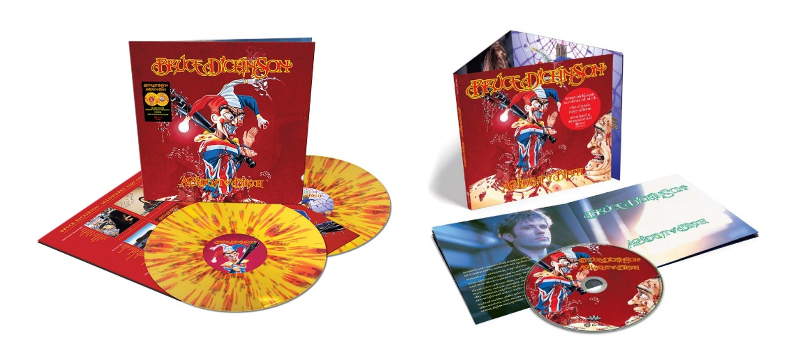
That brings us to the remix. Brendan Duffey is no stranger to Dickinson’s world, having worked on 2024’s The Mandrake Project, the singer’s first solo album in nearly two decades, and on last year’s reimagined More Balls To Picasso. The pair have spent the last couple of years going back through the solo catalogue together and remixing it for Dolby Atmos, and Dickinson is clearly enjoying the process, describing Accident Of Birth as a record that contains some of his very best work, one that relit his creative fire as a songwriter and gave him the chance to work with Smith again. The physical editions are handsome, a tri-panel digisleeve CD and a gatefold double vinyl pressed on yellow and red splatter, and keen-eyed collectors will notice that the vinyl sequence has been shuffled to fit four sides, with Omega moved up to sit alongside Darkside Of Aquarius and Road To Hell relocated to the final side. It is also worth noting what is not here. The Ghost Of Cain, the Dickinson and Smith co-write that appeared only on the American and Japanese editions, does not feature, nor do any of the demos and alternate versions that padded out the 2005 expanded reissue. This is the album as it was originally sequenced on CD, no more and no less.
The title has a story behind it, and it is not a comfortable one. Dickinson was born in Worksop in 1958 to parents who were barely out of their teens and was largely raised by his grandparents for the first six years of his life. He has spoken over the years of being, in effect, a child who was never meant to arrive, and the phrase “accident of birth” is his wry, rather bleak way of owning that. The title track itself, Dickinson once explained, is about a family from Hell, a twisted mirror held up to that idea. The cover, meanwhile, is pure Derek Riggs, the artist who gave Iron Maiden their mascot Eddie and painted all of their classic sleeves. His contribution here was a malevolent jester puppet, jokingly christened Edison, as in Eddie’s son, bursting out of a man’s stomach with a grim reaper lurking faintly in the background. It was deemed too graphic for American shelves, where the record went out with an entirely different frontal shot of the puppet, and the European version was cropped, so for many fans the full, unedited image only became familiar through later reissues.
Remixing a beloved album is always a risky business, and it is worth being clear about what a project like this can and cannot do. A remaster tidies up the finished stereo master; a remix goes back to the multitrack tapes and rebuilds the balance from scratch, which means every decision made in 1997 about how loud the guitars sit, how much reverb hangs on the vocal and how hard the drums hit is up for renegotiation. Done well, it can reveal detail that was buried and give an old record the punch of a new one. Done badly, it can sand off the very rough edges that made people fall in love with it in the first place. The original Accident Of Birth was mixed by Stan Katayama and Joe Floyd across two studios, and while it sounded big for its era, it also carried the slightly boxy, compressed sheen of a mid-nineties rock production. The Atmos dimension adds another layer of intrigue; Roy Z’s arrangements were dense with overdubbed guitars, strings, and keyboard textures, exactly the kind of material that can bloom when given space to move around a listener rather than being crammed into two speakers.
Freak opens the record, and it remains one of the great statements of intent in Dickinson’s catalogue. After the alternative-leaning textures of Skunkworks, the sheer heft of that opening riff must have come as a jolt in 1997, a chunky, muscular stomp that owes more to the heavy end of the decade than to the galloping NWOBHM template, yet it is unmistakably metal from its first bar. Dickinson attacks the vocal like a man who has been waiting years to let rip again, and the chorus is as defiant as the title suggests. If any song on the album stands to gain from a modern remix it is this one, because its power lies almost entirely in weight and impact, and how much extra low end Duffey can wring from those guitars without turning the whole thing to mud will set the tone for everything that follows.
Toltec 7 Arrival is barely more than half a minute long, a brief, eerie instrumental bridge that clears the decks before the next onslaught. On the original it felt like a palate cleanser and little more, but this is precisely the sort of atmospheric fragment that could take on a new life in Dolby Atmos, where a few swirling textures can suddenly feel like they are moving around the room. It is a small piece, but in a sequence that lives and dies on dynamics, its job is to make the next track hit harder.
Starchildren duly obliges. A slower, grinding piece with an almost doom-laden swagger, it is built around a lumbering riff that Smith and Roy Z lock together like interlocking gears, and Dickinson’s vocal swings between menace and soaring melody with remarkable ease. A demo version later surfaced on the 2005 expanded edition, and comparing the two shows just how much muscle Roy Z added in the studio. There is a heaviness here that Maiden rarely touched, a reminder that Dickinson’s solo work was never simply a holding pattern between stints in the day job but an outlet for ideas that would not have fitted anywhere else.
Taking The Queen is where the album first reveals its more dramatic, theatrical side. It is the first of three tracks to feature the strings of Silvia Tsai and Rebecca Yeh, and the arrangement builds patiently, the brooding verses giving way to a chorus that carries the weight of real tragedy, Dickinson’s performance a lesson in restraint and release. The strings are the element to listen for in the new mix; on the original they were tucked neatly into the background, and there is every chance this is where the remix reveals the most hidden detail.
Darkside Of Aquarius is the album’s epic, its longest track at well over six minutes and one of its true centrepieces. A sprawling, multi-part piece steeped in apocalyptic imagery and Dickinson’s fascination with the esoteric, it shifts through a series of movements, from its powerful opening charge to a heavier, more deliberate final section that gives Smith and Roy Z room to stretch out. It is also one of the songs Dickinson has brought back into his live sets on recent tours, which says plenty about how highly he still rates it. If any track on the album was written with something like Atmos in mind, even if nobody knew it at the time, it is this one.
Road To Hell is the album’s sprint, a Dickinson and Smith co-write that comes in at under four minutes and positively crackles with energy. It is the closest thing on the record to a classic Maiden-style anthem, built on a bright, driving riff and a chorus engineered to be bellowed back by thousands, and it is no surprise that it was one of the songs the band shot a promotional video for, filmed on the same day as the clip for the title track. Hearing Smith’s instantly recognisable melodic touch on lead guitar here is a joy, and the chemistry between him and Dickinson, rekindled after years apart, practically leaps out of the speakers. It too has earned a regular place in Dickinson’s recent solo sets.
Man Of Sorrows is the album’s emotional heart and arguably its most enduring song. Written by Dickinson alone, it is a piano-led ballad featuring Richard Baker on keys and the album’s string section, and it has a remarkable history. Dickinson has explained that it is about Aleister Crowley as a boy, and an earlier version had actually been recorded back in 1990 with Janick Gers on guitar, intended for a film project that would eventually, many years later, become the 2008 movie Chemical Wedding. Released as the album’s second single, it later appeared in Spanish as Hombre Triste and in an orchestral version, and it remains a staple of Dickinson’s live sets, even turning up in a cappella form at his spoken word shows. Of all the songs on the record, this is the one where a lighter touch is needed in the remix; its power lies in its vulnerability rather than its volume.
Accident Of Birth, the title track and lead single, is the record’s defining moment. Opening with a call to journey back to the dark side, it is built around a fat, rolling riff and a chorus that refuses to leave your head, and its lyrical theme, a family from Hell, gives it a gleefully macabre edge. The single peaked at number 54 in the UK and came with a video featuring the Edison puppet in all its sinister glory. Live, it has become one of Dickinson’s most dependable solo moments, and nearly thirty years on it still sounds like the work of a band with a point to prove. This is a song that needs to sound enormous, and on paper, the remix should make sure it does.
The Magician is the album’s most divisive track, and even some of the record’s most ardent admirers have singled it out as its weakest link. Another song touching on Dickinson’s long-running fascination with the occult, it is shorter and more straightforward than much of what surrounds it, and on the original it felt slightly underpowered compared with its neighbours. It segues neatly out of Man Of Sorrows rather than standing fully on its own feet, and a remix is unlikely to transform it into a classic, but it may at least sharpen its edges and give it a little more bite.
Welcome To The Pit is the second Dickinson and Smith co-write and one of the album’s darker, sleazier moments. Built on a slow, grinding groove with a seductive menace about it, it is a reminder that Smith’s contributions to Maiden were always about more than melody; he could write a riff with real swagger and bite. Dickinson’s vocal leans into the song’s predatory atmosphere, and there is a looseness to the playing that gives it a pleasingly dangerous edge.
Omega was the first taste of the remix to be released, which is telling in itself. At more than six minutes it is the album’s second epic, a brooding, building piece that rises from a quiet, ominous opening into a towering finale, and it has long been one of the most admired songs on the record among the hardcore fanbases. Choosing it as the first remixed track to share suggests Dickinson and Duffey feel it best showcases what the new mix can do and given its slow-build structure and layered arrangement, which makes complete sense. It is precisely the sort of track that should benefit from extra width and clarity, the dynamic shifts landing harder when each layer has room to breathe.
Arc Of Space closes the album on an unexpected note, an acoustic piece with strings that drifts into the cosmos rather than ending on a crash. After an album of such ferocity, it is a gentle, reflective full stop, and it shows how far Dickinson had grown as a songwriter by this point in his career, comfortable enough to end a comeback record not with a bang but with a quiet, wistful look towards the stars. It is a beautiful way to sign off, and in the new mix the acoustic guitars and strings should sparkle.
What stands out, revisiting Accident Of Birth as a whole, is how complete it feels. There is no filler to speak of beyond the odd weaker moment, the sequencing flows superbly from brutal to balladic and back again, and the balance between Roy Z’s heavier, more contemporary instincts and Smith’s classic melodic sensibility gives the record a texture that neither man could have achieved alone. Dickinson, meanwhile, sounds liberated. Freed from the expectations that came with fronting Maiden and the pressure of reinventing himself on Skunkworks, he simply sings like the best heavy metal vocalist of his generation, which, frankly, is what he was. It is also striking how well the record has aged lyrically. Its preoccupations with the occult, with fate, with damnation and with the strange luck of simply being alive have never gone out of fashion in heavy metal, and Dickinson’s writing here has a literate, slightly mischievous intelligence that stops it ever tipping into cliché.
The bigger question, of course, is whether this remix is necessary at all. Purists will argue, with some justification, that the original mix is part of the album’s DNA, and that no amount of modern polish can or should replace the sound people first heard in 1997. There is truth in that. But the counterargument is equally strong: the original was a product of its time and its budget, mixed across two studios, and if the man who made it wants to hear it the way it sounded in his head, there is a legitimate artistic case for doing so. Dickinson and Duffey have form here, too. Their partnership on The Mandrake Project produced one of the most sonically ambitious records of Dickinson’s career, and their earlier work revisiting Balls To Picasso showed a willingness to rethink rather than simply buff up. The original stereo mix is hardly going to disappear, and nobody is being forced to choose; this is an additional way of hearing an old favourite rather than a replacement for it.
There is also a wider context worth considering. Dickinson is currently in one of the busiest phases of his long career, and reports suggest an eighth solo album is already in the can, tentatively pencilled in for early 2027. Revisiting Accident Of Birth now, with four of its songs having become fixtures of his recent solo setlists, feels less like nostalgia and more like a deliberate reminder of the foundations on which that renewed solo career is built. Placing the record in the spotlight for National Album Day only reinforces that this is meant to be heard from start to finish, as an album in the truest sense.
Ultimately, the quality of the remix will be judged by every listener on their own terms and their own systems, and the true test will come when the full record arrives. But the songs themselves are beyond question. Accident Of Birth was the album that rescued Bruce Dickinson’s solo career, rebuilt his bridge back to heavy metal and laid the groundwork for his homecoming to Iron Maiden. Nearly thirty years on, it has a strong claim to being the finest record he has made outside of that band, and any excuse to revisit it at full volume is a welcome one. As the man himself put it, turn it up loud.
Accident Of Birth (2026 Remix) – Track listing:
1. Freak
2. Toltec 7 Arrival
3. Starchildren
4. Taking The Queen
5. Darkside Of Aquarius
6. Road To Hell
7. Man Of Sorrows
8. Accident Of Birth
9. The Magician
10. Welcome To The Pit
11. Omega
12. Arc Of Space
Line-up (1997 recording):
Bruce Dickinson – Vocals
Adrian Smith – Guitar
Roy Z – Guitar
Eddie Casillas – Bass
David Ingraham – Drums
Website:
Spotify:
Instagram:
https://www.instagram.com/brucedickinson
Facebook:
https://www.facebook.com/brucedickinson
X:
8/10