Review & Photography by Nathan Vestal for MPM
Reggie’s Music Joint already feels like a place that knows too much.
By the time the first bodies filtered into the room on Wednesday night, May 6, the place had that South Side voltage: dim lights, old brick, a bar running like a steel nerve through the room, booths tucked close enough to the stage to make every performance feel personal, and the kitchen breathing out that strange Reggie’s perfume, burnt and greasy and somehow criminally appetizing. Stickers, band logos, blunt little declarations, sports relics, and rock memorabilia covered the place like a neighborhood dive had swallowed a record store and decided to keep the evidence.
The staff carried the same useful South Side economy as the room itself: friendly enough to keep the machine moving, not so friendly that anyone mistook the night for a hospitality seminar.
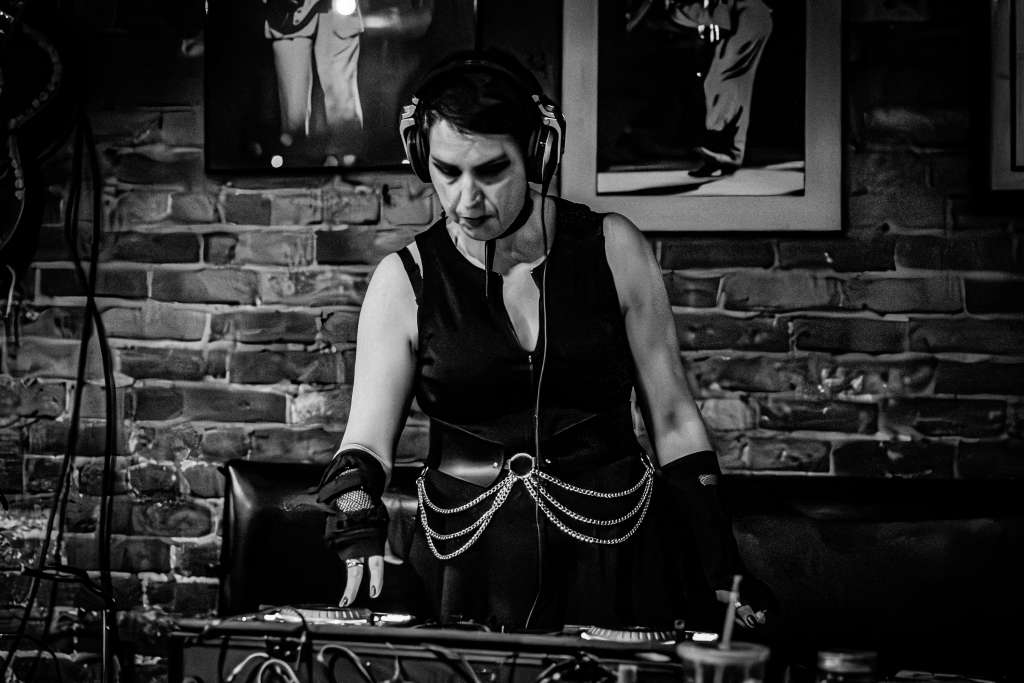
DJ Veganinblack had the pulse lit before, between, and after sets, stitching the evening together with goth, industrial, and darkwave, less scene interrupter than shadow traffic controller, guiding the night’s nervous system without ever breaking the spell.
The bill itself had a stripped-down design: Black Season Witch, SINE, and Curse Mackey each working with a lean stage footprint and handling equipment. Relying on atmosphere and crowd command without the safety net of a full visible army. It made the room feel less like a concert and more like a series of controlled hauntings.
Black Season Witch: The First Incantation
Black Season Witch opened the night like a candle being lit in a basement no one had fully inspected.
The Chicago goth act took the stage in solitary form, seated first with cello, the instrument carving out a low, mournful threshold before the set shifted into bass and backing tracks. The movement was minimal, almost ceremonial. Sit. Play. Rise. Stand with bass. Let the screen behind do some of the creeping. Return to the cello. It was not a performance built on spectacle in the traditional sense. It was built on pressure, patience, and mood.
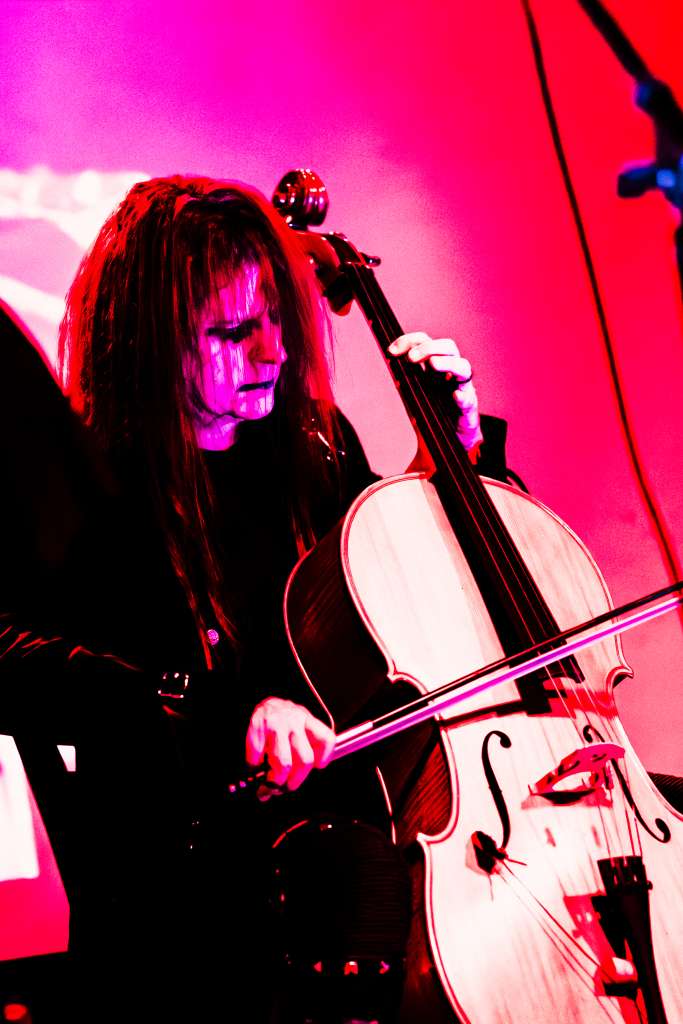
Behind the performer, projected imagery crawled across the wall, giving the stage the feeling of a private séance happening in public. The voice arrived with a possessed-storybook chill, theatrical but controlled, suggesting menace without tipping into parody. Black Season Witch’s own bio describes them as landing somewhere between Type O Negative and Sisters of Mercy, and that reference point made sense in the room: doom-goth gravity on one side, graveyard romanticism on the other, with the set functioning as the night’s opening wound.
The most effective thing about the performance was its refusal to chase the crowd. It did not beg. It did not lunge. It simply stood there and let the atmosphere gather around it.
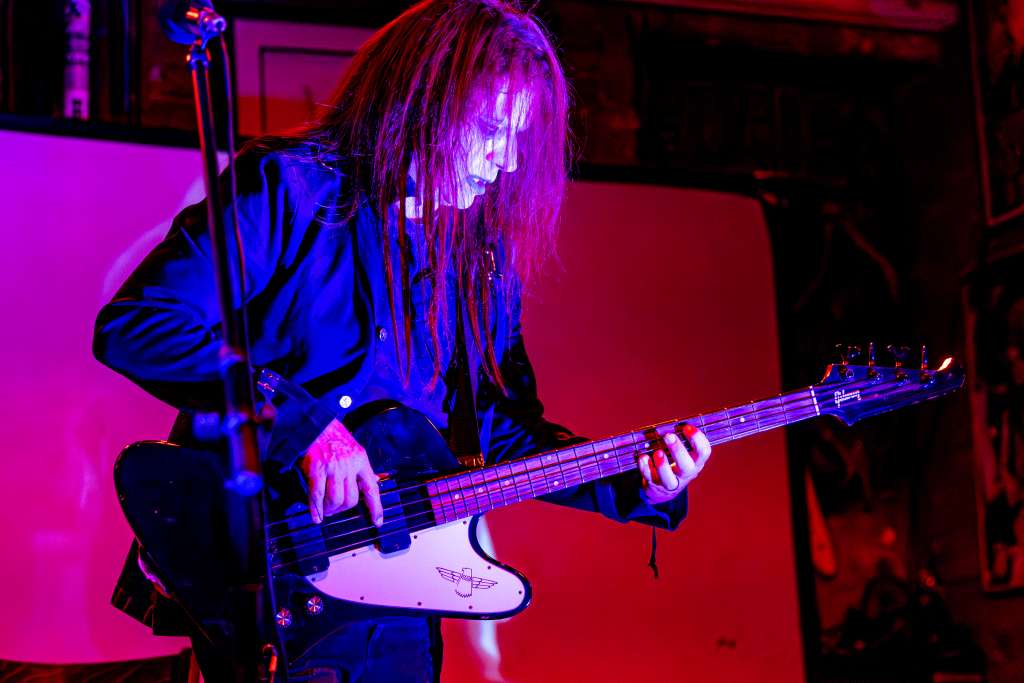
Then came the closing gesture: “Children of the Grave,” offered simply with, “This one is for Ozzy, RIP.” That was the only real address to the room, and it fit. No speech was needed. Hanging behind the stage, as a permanent piece of Reggie’s visual mythology rather than anything staged for the moment, a Black Sabbath poster watched over the whole thing with accidental perfection. The coincidence did more work than planning ever could: one black flag already nailed to the wall before the night moved deeper into the dark.
SINE: Cut the Lights
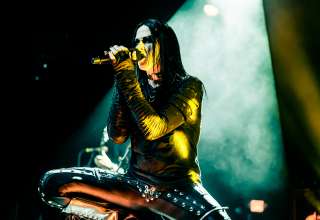
When Rhona Rougeheart took the stage with SINE, the room changed temperature.
The already dark club became smaller, closer, more dangerous in the theatrical sense. Rougeheart would not begin until the lights were cut, and it did not read as diva behavior. It read as command. Not a request. A correction. The kind of stage instinct that knows exactly what the room is supposed to become and refuses to perform inside the wrong skin.
SINE came into Reggie’s carrying new material that landed like fresh ammunition. The Austin-based alternative electronic project, created and led by singer and drummer Rougeheart, has a new full-length, La Mordre, arriving through Metropolis Records, and the room got treated to “Cruel” live for the first time. That mattered because it did not feel like a preview. It felt like a warning shot. “Blood & Wine” followed close behind, another new single and Rougeheart’s first self-produced release. It carried the confidence of someone not only fronting the machine, but tightening every bolt herself.
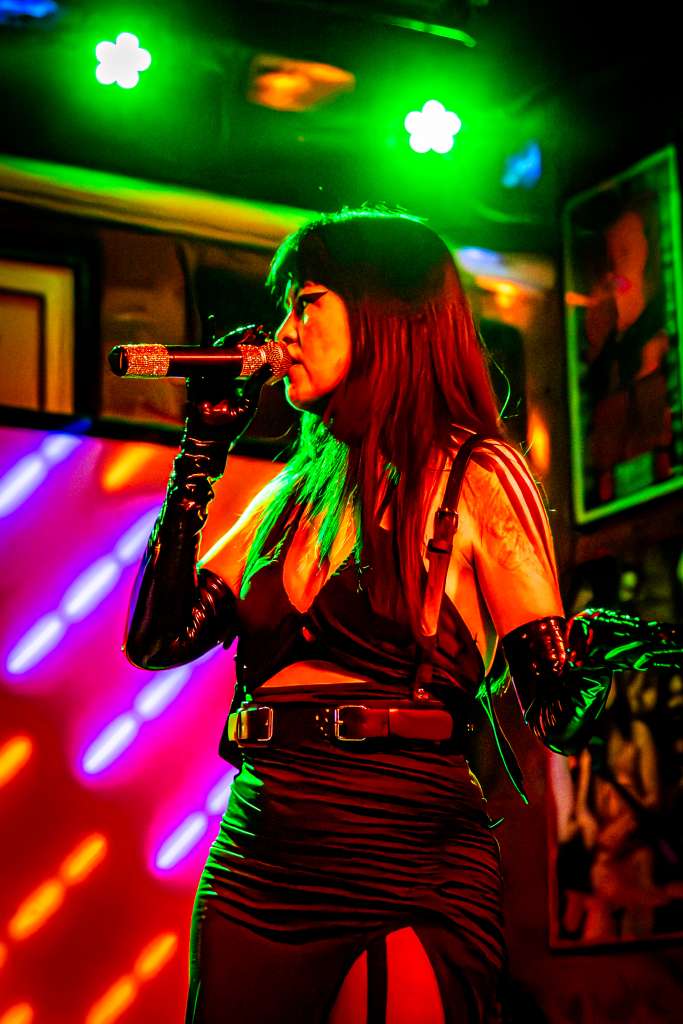
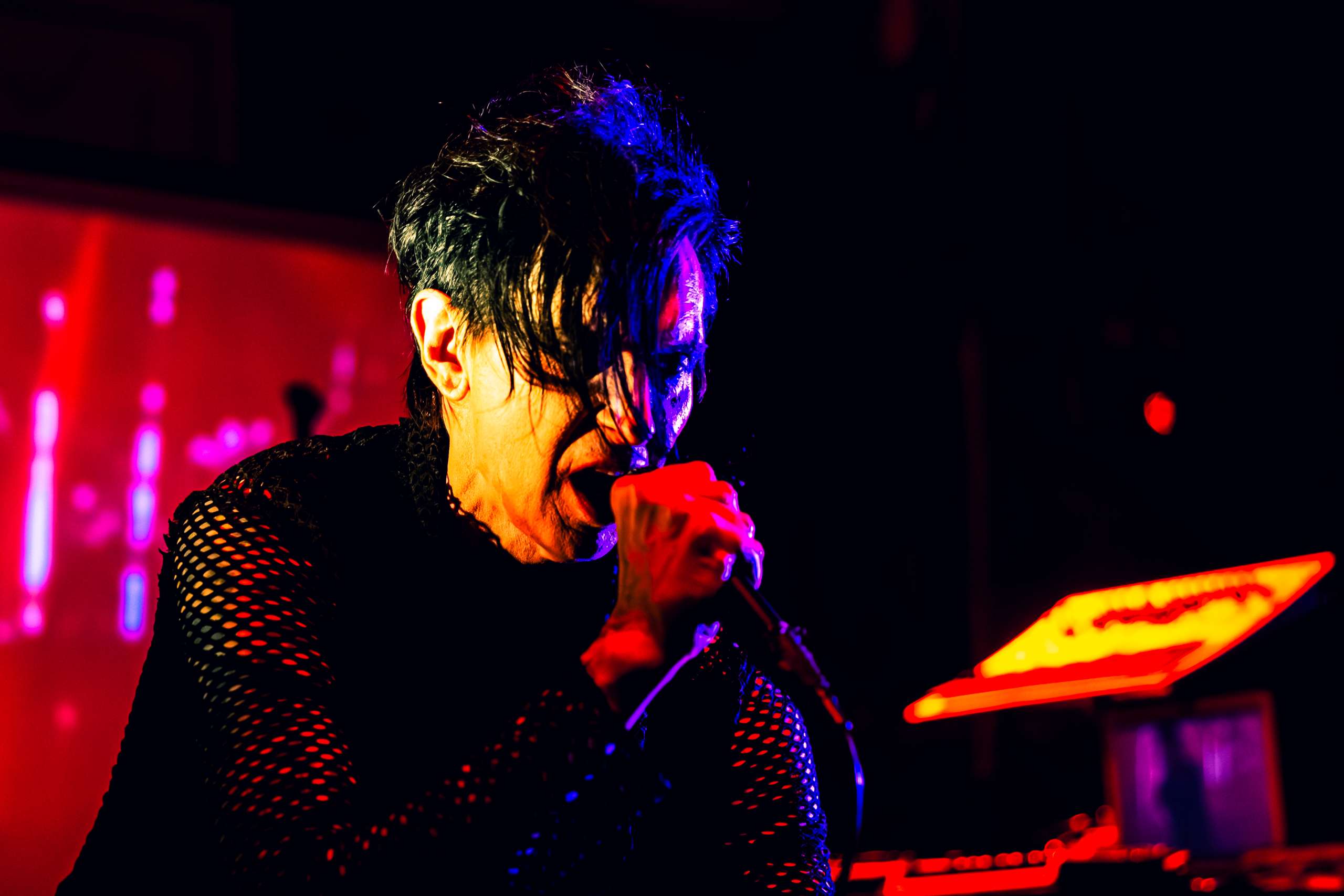
The lights became part of the body language. Blinking strobes turned the stage into a peepshow of fragments: Rougeheart’s face, a patent gloved hand, a leg, a flash of movement, then darkness again. Songs like “Control” played into that visual grammar, all tension and invitation, less seduction than power exchange with a bassline. During “Succumb to Me,” the monitor vibrated itself right off the stage and had to be rescued by the photographer-author, a perfect little Reggie’s moment: industrial glamour interrupted by blunt physics.
Videos rolled on the projector, but almost nobody watched them. Rougeheart had the room by the throat in the old nightclub sense, not with volume alone but with magnetism. Some performers fill a stage by moving across every inch of it. Rougeheart did it by making the air move toward her.
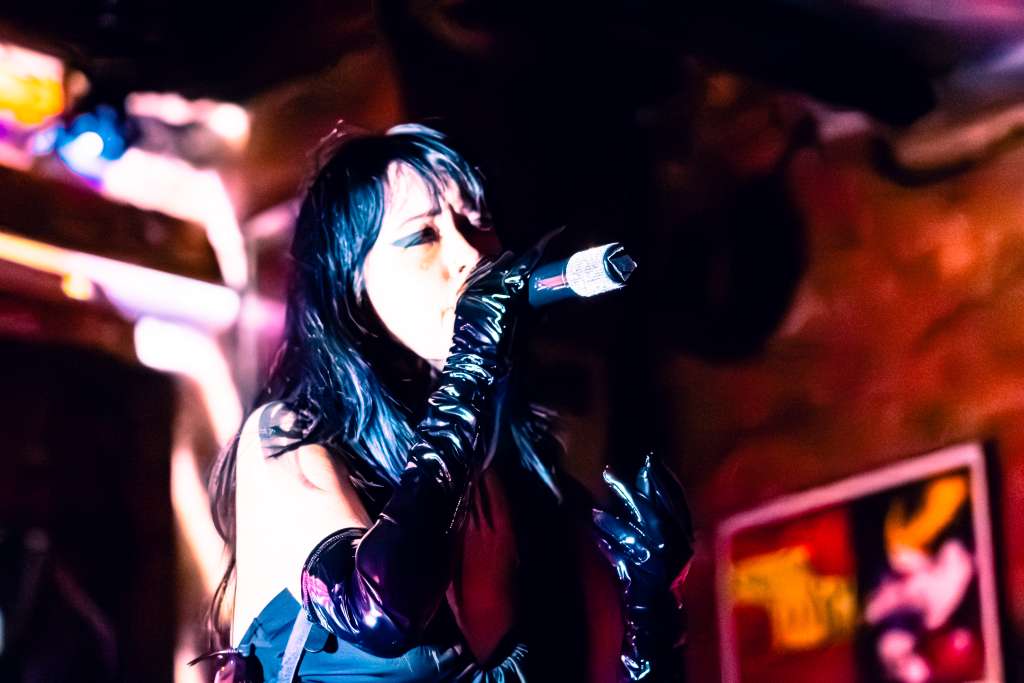
She thanked Chicago and the crowd for showing up on a Wednesday night, a small human seam in a set otherwise built from strobes, sweat, and command. That gratitude mattered. It broke the spell just enough to remind everyone that this machine had a pulse.
Curse Mackey: Everybody Gets the Front Row
Curse Mackey did not so much begin as detonate.
The bass hit first, hard enough to make the floor feel briefly negotiable. After SINE’s shadowbox intimacy, the return of strobes and stage lights felt less like brightness than escalation. Good thing somebody added gaffer’s tape to steady the monitors, because Mackey came in with the kind of low-end assault that makes unsecured objects consider migration.
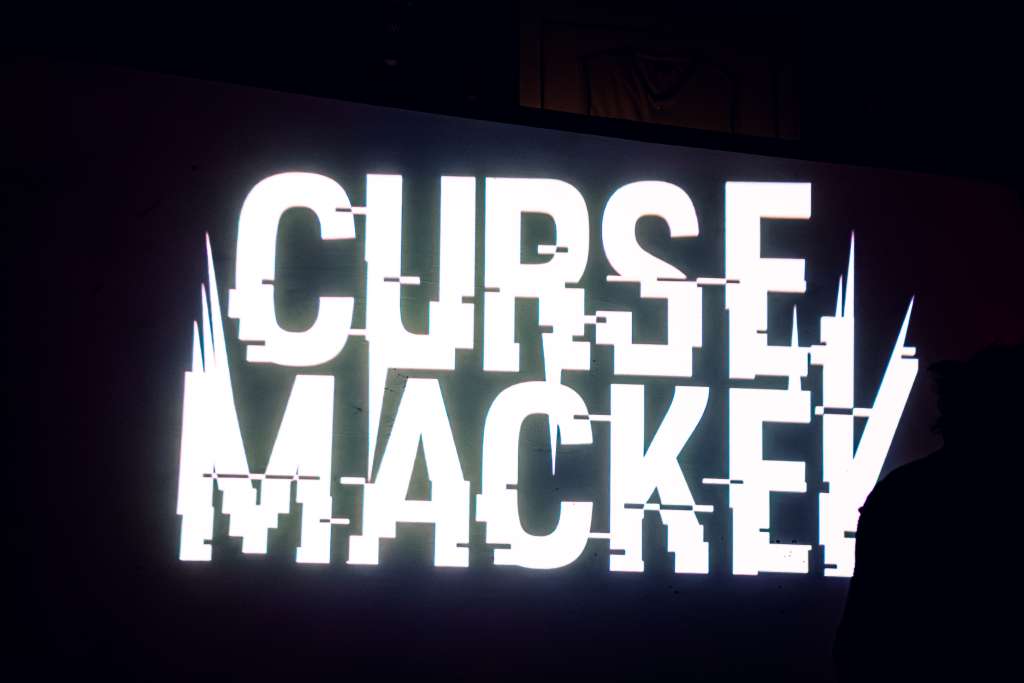
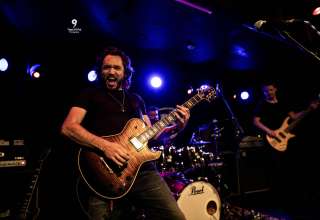
Mackey arrived in Chicago carrying more than a solo set. He carried history. The Austin-based industrial artist is known for his work with Pigface, Evil Mothers, and My Life with the Thrill Kill Kult, with the Chicago connection running deepest through Pigface and the city’s larger industrial bloodstream. That mattered because the room had the feel of an industrial family reunion with better boots and darker shirts. Pigface and Museum of Post Punk & Industrial Music shirts were everywhere, less merch than tribal evidence. Mackey’s association with that world made his Reggie’s set feel less like a touring stop than a return to a family table where the knives are kept sharp.
So when Mackey took control of the stage, the night folded time in on itself. Former bandmates, fans, friends, and the chosen industrial family all seemed to be standing in the same current. Reggie’s was no longer just a club on South State Street. It was a pressure chamber for a scene that has always understood rust, circuitry, grief, volume, and survival.
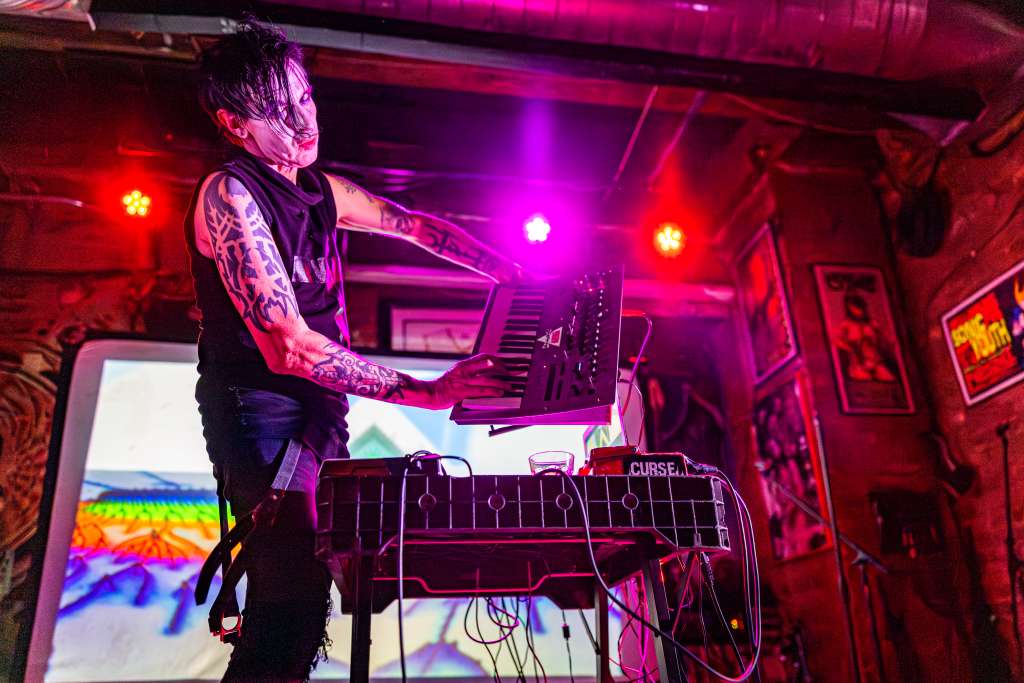
But the emotional architecture of the set was clear. He pounded the keyboard like he was trying to get a confession out of it, voice cutting through electronics that felt cinematic without becoming polished smooth.
Mackey’s set leaned hard into Imaginary Enemies, his 2025 release, and the choice gave the performance a present-tense urgency. This was not a nostalgia pass from an artist with old credentials to cash in. It was a current transmission from someone still dragging new ghosts into the light. “A War to Call Home” and “Lacerations” opened the door with force, all pressure and abrasion, the kind of industrial body-blow that makes a small room feel like it has been rewired from the inside.
From there, the set moved less like a playlist than a controlled descent. “Somewhat Possessed,” “The Reveal,” and “Doomed for Monday” carried that Mackey balance of menace and melody, the keyboard getting worked like a piece of evidence under interrogation. He pounded at it with both command and urgency, voice cutting through the electronics without smoothing off the edges. Nothing felt ornamental. Every sound had a job to do, and most of those jobs involved damage.
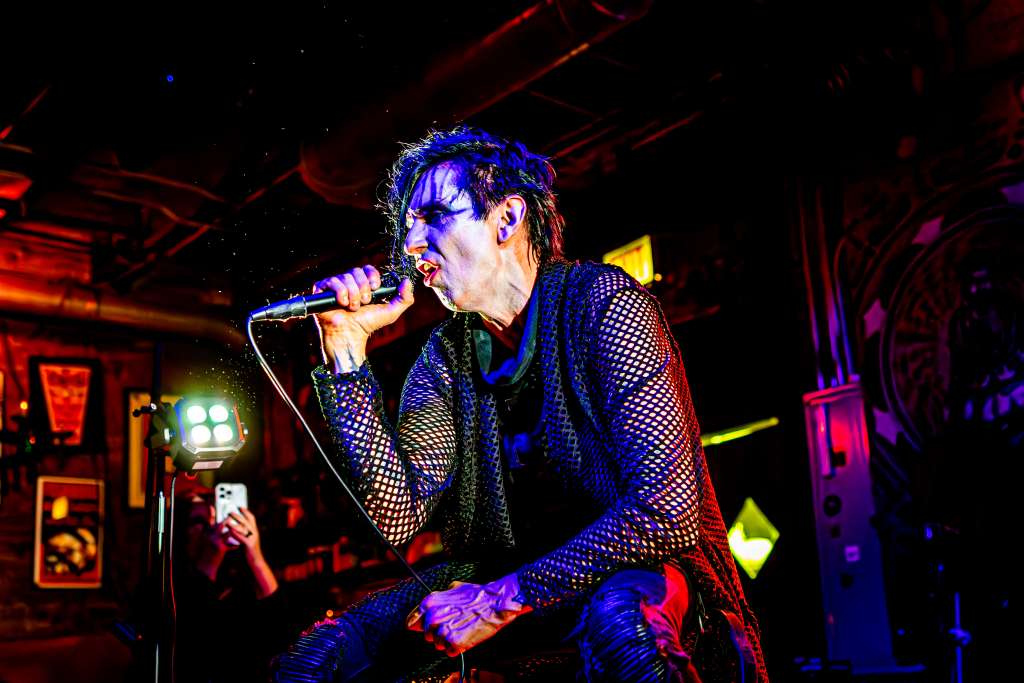
By the time “Vertigo Ego” and “Discoccult” hit, the Music Joint had fully surrendered to the machinery. The room’s closeness became part of the performance: the bar still breathing, the kitchen still throwing out that burnt-grease perfume, the audience packed close enough to read every gesture. Reggie’s did not give the crowd distance. It gave them exposure.
Then came “The Kindness of Serpents,” the Imaginary Enemies track containing the line, “Everybody wants front row for the end of the world.” In a small room like Reggie’s, with its corner stage and close quarters, that lyric felt less like dystopian poetry than crowd logistics. Everyone more or less had the front row. Everyone had a clean view of the countdown.
Maybe Mackey was foretelling something. Maybe he was just honest enough to admit that apocalypse sells better when the sightlines are good.
The emotional drop came with “Blood Like Love,” also from Imaginary Enemies. Mackey sent it out to those who could not be there, “probably due to their own bad decisions or being in the wrong place at the wrong time.” The line had the shape of gallows humor, but the song did not move like a joke. It slowed the room down. After the earlier impact, “Blood Like Love” felt like the floor giving way, not violently, but with that awful softness grief sometimes has when it finally gets through the armor. Mackey did not wire sorrow into a beat here so much as let it stand under the lights, bruised and breathing, while the room went quiet enough to feel the weight of who was missing.
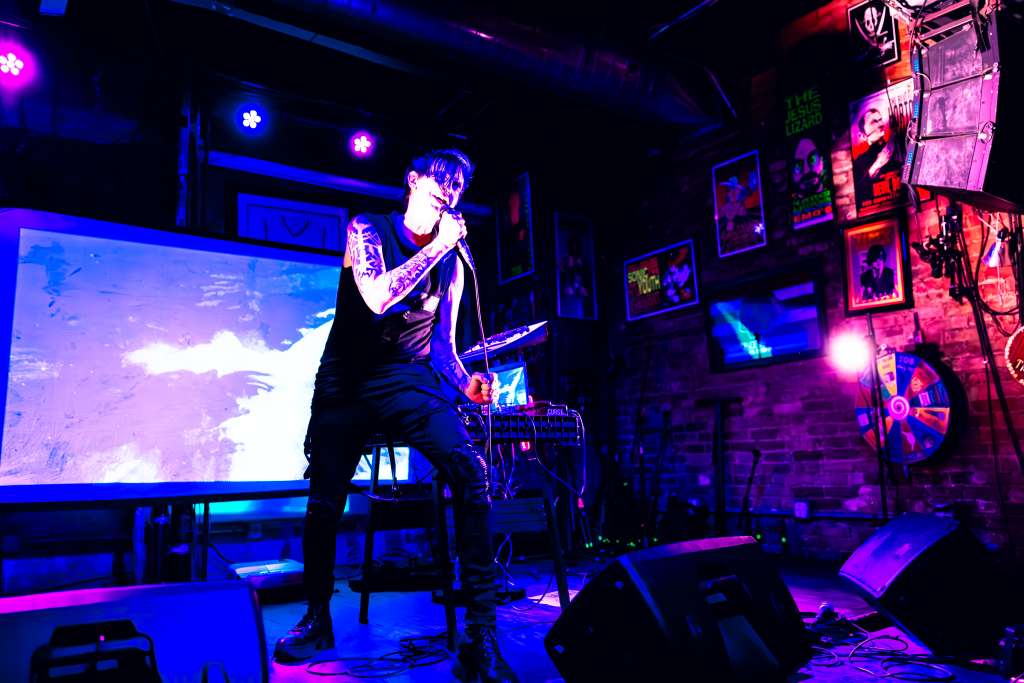
That was the set’s hinge. Afterward, “O’Blasphemy,” “Secrets of the Resurrection,” and “Six Ghosts of Fear” pulled the night back toward ritual and release, the titles alone sounding like chapters torn from some burned industrial hymnal. Then, almost as quickly as it had erupted, the show ended. Mackey closed not by easing the crowd down, but by cutting the current. The ending felt abrupt, almost severe, as if the machine had given everything it was built to give and then simply stopped sparking. It suited Mackey’s presence: intense, concentrated, unwilling to pad the ritual once the voltage had left the room.
And really, what more needed to be said?
By the end of the night, Reggie’s felt used in the proper sense. Not trashed. Activated. The stickers barking from every surface, band logos layered like scar tissue. The kitchen smell still drifted through the club in that impossible burnt-grease perfume. The staff kept moving with their practical half-smiles. The industrial old guard and new blood lingered in the afterglow, talking, remembering, reconnecting.
The best shows do not simply entertain a room. They alter its chemistry. On May 6, Curse Mackey, SINE, Black Season Witch, and DJ Veganinblack turned Reggie’s Music Joint into something smaller, darker, and more alive than it had been a few hours earlier. A Wednesday night in Chicago became a family reunion at the edge of the machine.
Everybody wanted front row for the end of the world.
For once, everybody got it. With a bang.