Review & Photography by Nathan Vestal for MPM
By the time anyone got near The Salt Shed on June 3, Chicago had already started playing opening act. Not music. Something uglier. Traffic. Construction. Parking lots packed tight enough to feel personal. The kind of civic chokehold that makes a ten-minute approach mutate into a slow-motion hostage situation. Around the venue, cars crept, brake lights bled red across the pavement, and every turn seemed to lead into another clot of frustration.
That is how Les Claypool’s whole three-headed carnival began for some people: not with bass, not with lights, not with the first warped note of Les Claypool’s Fearless Flying Frog Brigade, but with Chicago doing what Chicago does best, making you earn the room.
The Frog Brigade was missed, swallowed somewhere between construction cones, Salt Shed gridlock, and the miserable little math problem of where to put a car when everyone else had the same bad idea at the same bad time. That absence hung in the night like a bruise. Not enough to ruin the evening, but enough to sharpen it. By the time the crowd finally made it inside, there was already sweat on the neck, irritation in the jaw, and that half-feral sense that the city had taken its pound of flesh before the music got a chance.
The Salt Shed itself felt built for that mood. Industrial without pretending. A converted Chicago husk with enough steel, brick, concrete, and river-adjacent grit to make sound feel physical before the PA even opened its mouth. It is not a room that politely receives music. It absorbs it, sweats it back out, and lets the crowd stand inside the residue.
This was Claypool Gold, less a standard tour package than a strange family reunion inside Les Claypool’s skull: Primus, The Claypool Lennon Delirium, and Colonel Les Claypool’s Fearless Flying Frog Brigade all orbiting the same cracked sun. The promos described it as a full-evening tour bringing together three of Claypool’s most adventurous projects, but on the ground, away from the clean ticketing language, it felt stranger and more human than that. It felt like a night where one man’s entire musical nervous system had been spread across a stage and wired directly into a crowd willing to twitch along.
The Missed Door: Frog Brigade Plays Somewhere Beyond the Gridlock
There is a particular kind of disappointment that comes from missing a band you intended to see. Not because you were lazy. Not because you misjudged the night. Because the city simply folded itself around you and refused to open.
That was the Frog Brigade portion of the evening for anyone trapped outside in Chicago’s roadwork labyrinth. Somewhere inside, the night had already begun its first weird ritual while outside, headlights idled in place and people negotiated with fate, parking apps, and their own rising blood pressure. The Frog Brigade became less a performance than a ghost heard through the walls of circumstance. A rumor. A punishment. A reminder that live music does not pause just because traffic has decided to become a villain.
Still, that missed piece gave the rest of the evening an edge. Once inside, the crowd did not feel casual. They felt slightly battered, pre-agitated, ready to be rewarded for surviving the asphalt purgatory outside. The Salt Shed had the mood of a loading dock after midnight, only now the cargo was weirdness, volume, and people who had come to watch Les Claypool bend bass guitar into a language not approved by any known governing body.
The absence of Frog Brigade did not leave an empty hole as much as it created a fuse. By the time The Claypool Lennon Delirium took shape, the audience had already been processed by the city, shaken loose from normal patience, and delivered to the stage in a state perfectly suited for psychedelic bass damage.
The Side Door: The Claypool Lennon Delirium Slips Reality Off Its Hinges
The Claypool Lennon Delirium does not move like a side project. It moves like a hallucination that got a rehearsal schedule.
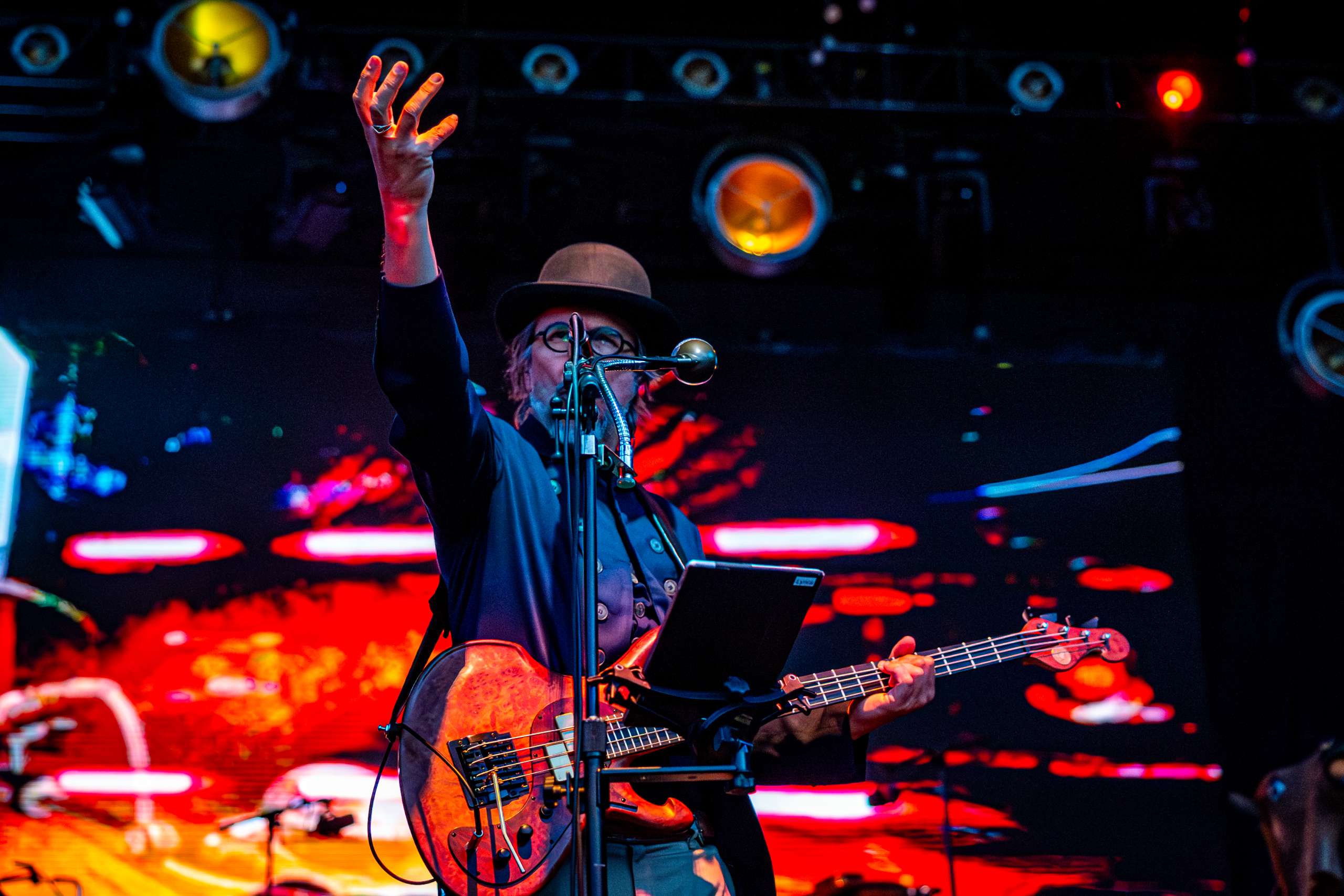
Les Claypool and Sean Ono Lennon stood at the center of it with the odd chemistry of two musicians who understand that weirdness only works when the craft underneath is deadly serious. Claypool, all angles and elastic menace, handled the bass as if it were both weapon and farm tool, plucking, snapping, and wringing it until the low end seemed to grow legs. Lennon brought a different gravity: cooler, dreamier, more spectral, his guitar and voice pulling the music sideways into color-streaked fog.
The project has long been built around the collision of those two sensibilities: Claypool’s mutant funk and Lennon’s psychedelic lineage. Onstage, that collision did not feel nostalgic or contrived. It felt damp, electric, and pleasantly unstable, like someone had opened an old laboratory freezer and found the experiment still breathing.
The Delirium’s music works best when it feels like it is about to either levitate or fall down a staircase. At The Salt Shed, it did both. Songs bent into odd corners. Rhythms slithered rather than marched. The keys added that carnival-after-the-power-out texture, while the drums kept the whole thing from evaporating into incense smoke. It was psychedelic, sure, but not soft. This was not flower-child drift. This was prog with dirty fingernails.
Claypool remained the axis, of course. He does not front a band so much as conduct an infestation. Every twitch seems intentional. Every grin feels like a dare. The bass lines popped and snapped through the air with that familiar rubber-band violence, each one landing somewhere between funk, swamp, cartoon physics, and mechanical failure. He can make an instrument sound expensive and disgusting at the same time, which is a rarer talent than people admit.
Lennon gave the set its haunted counterweight. Where Claypool lunged, Lennon floated. Where Claypool chewed through the rhythm, Lennon smeared melody across the ceiling. His presence kept the Delirium from becoming just another Claypool mutation. It made the music feel like a conversation between two strange bloodlines: one from the Bay Area freak-funk gutter, the other from art-rock royalty and lunar psychedelia.
The playlist had its own strange little arc, a Delirium travelogue through three records and several layers of brain fog. They opened with “Cricket and the Genie (Movement I, The Delirium)” from 2016’s Monolith of Phobos, letting the song’s crooked theatrical pulse establish the night’s psychedelic operating system. Then came the 2019 title track “South of Reality,” all woozy orbit and bent-prog drift, before the band reached into the brand-new 2026 album The Great Parrot-Ox and the Golden Egg of Empathy for tracks that made the set feel alive in the present rather than trapped in catalog worship.
And then came the strawberry vape incident.
Somewhere in the crowd, somebody’s cloud of artificial fruit rot reached the stage, and Claypool, never one to let an irritant pass without turning it into theater, called it out. Not just vaping. Awful smelling strawberry shit. It was the kind of moment that snapped the whole place back into its body. The crowd laughed because it was funny, but also because everyone knew exactly what he meant. In a room full of bass distortion, beer sweat, river air, and industrial dust, somehow the most offensive smell in the building was fake candy fog from a stranger’s pocket robot.
That tiny scolding became a perfect Delirium moment: absurd, annoyed, communal, and impossible to separate from the music around it. Claypool did not break the spell. He seasoned it.
The rest of the set kept warping around that looseness. The Delirium did not need to bludgeon the crowd. It infected them. Heads bobbed in odd time. Shoulders moved before people realized they were dancing. Closing with Pink Floyd’s “Astronomy Domine” was the right kind of inheritance ritual: not imitation, but a cosmic handoff filtered through Claypool’s swamp-funk wiring and Lennon’s moonlit guitar haze.
The Salt Shed, which had started the night feeling like a parking-lot survival shelter, became softer at the edges, stranger in the corners. The room loosened its belt. The night got weirder. Good.
The Trapdoor: Primus Drops The Salt Shed Into the Machine
Primus does not enter a room like a band trying to win anyone over. Primus arrives as if the room has already signed the waiver.
By the time they took over, The Salt Shed had shifted from psychedelic simmer to full Primus territory: that peculiar zone where the crowd is both in on the joke and completely at the mercy of it. Primus has always been a band built on contradiction. They are funny but not unserious. Technical but not sterile. Heavy without wearing heavy metal’s usual armor. Funky in a way that feels less like dance music and more like a machine shop developing a nervous disorder.
Les Claypool, Larry “Ler” LaLonde, and drummer John Hoffman make up the current Primus lineup, with Hoffman stepping into one of the most bizarre and demanding drum chairs in rock after the band’s widely publicized drummer search. That matters because Primus is not a band where the drummer simply keeps time. In Primus, time is the thing being hunted.
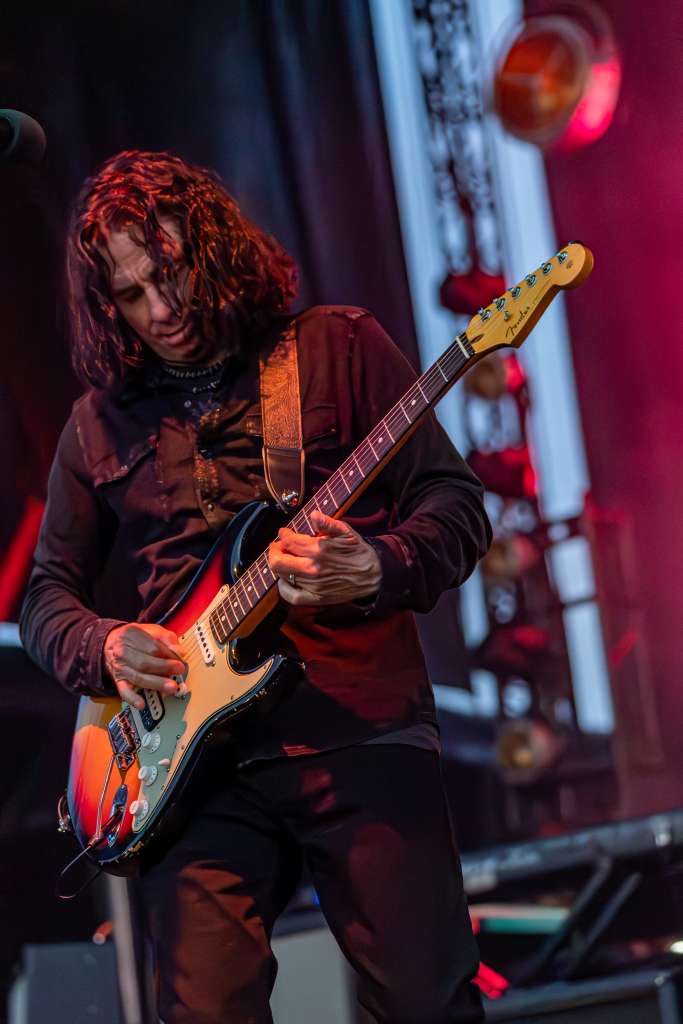
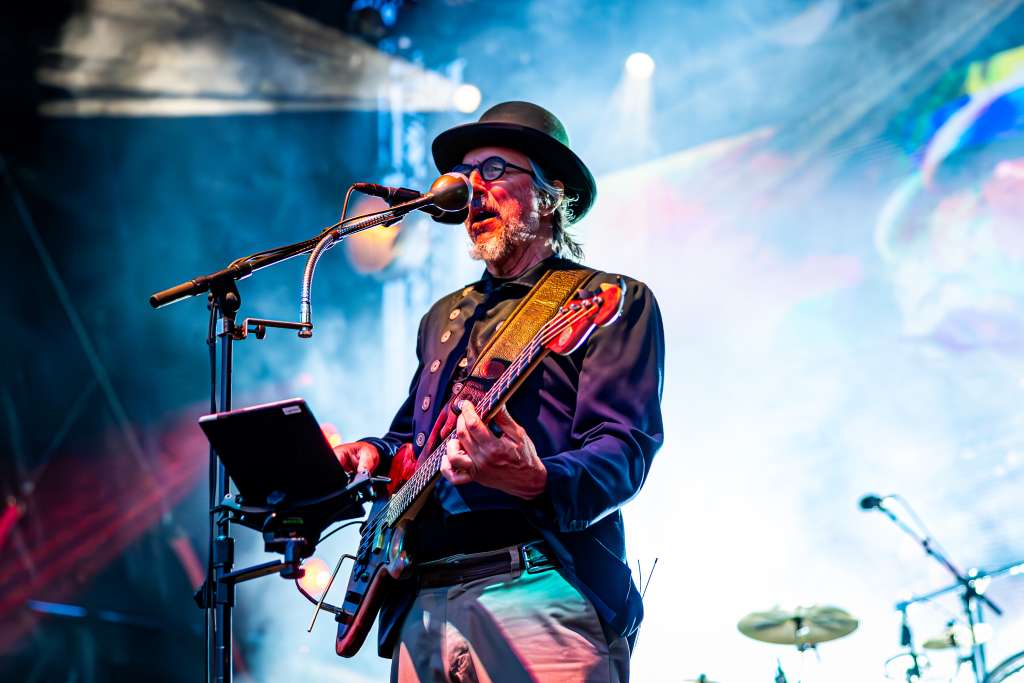
Claypool came out with the command of someone who understands that his audience does not want polish. They want personality with teeth. He gave them exactly that: crooked grins, elastic body language, and the unnerving sense that every pause was bait. Claypool does not need to beg for attention. The room leans toward him automatically, waiting for the next bass snap, sideways aside, or rhythmic trapdoor to open under its feet. He performs like a man steering a junkyard contraption downhill, grinning because the brakes were never part of the design.

LaLonde remains one of rock’s great odd-fit guitarists, which is exactly why he fits Primus so well. His playing does not muscle into the center. It scratches at the walls. It darts in and out of Claypool’s low-end architecture, sometimes needling, sometimes slicing, sometimes sounding like a radio transmission from a room nobody should enter.
And Hoffman had the unenviable task of making chaos feel lived-in. He did not just hold the line behind Claypool and LaLonde. He gave the line a pulse, a limp, a nervous system. Primus rhythms are full of trapdoors. The drummer has to know when to lock in, when to fracture, when to let the groove stagger without letting it fall into traffic. Hoffman played like someone who knew the assignment was not to imitate the past, but to keep the beast recognizable while teaching it a few new injuries.
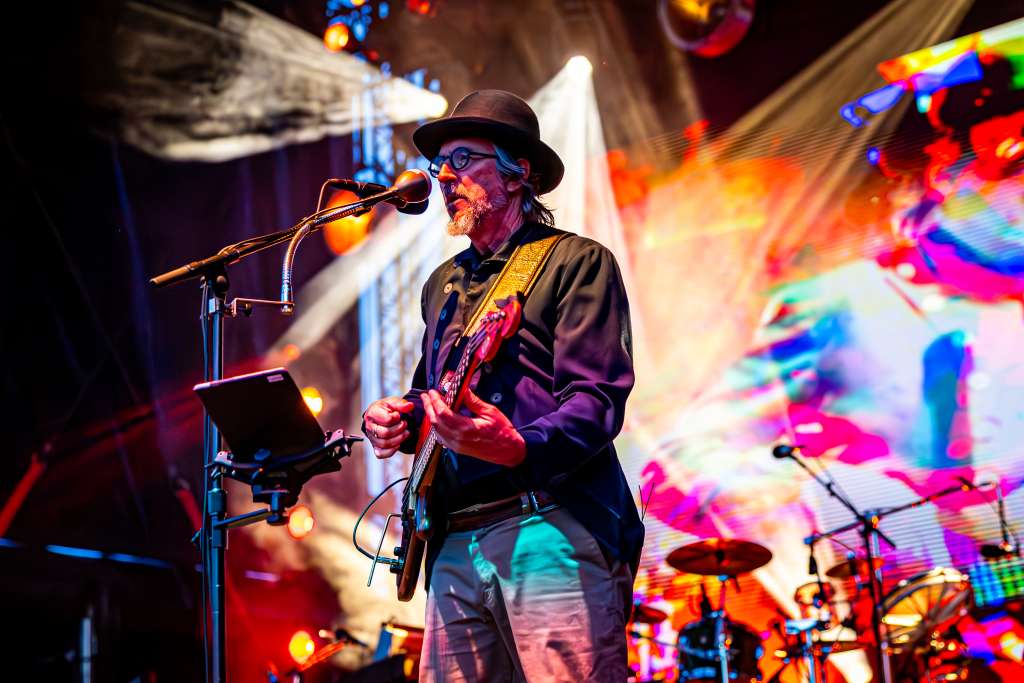
The crowd responded the way Primus crowds do, with a mix of devotion, laughter, and physical surrender. There is no normal way to move to this band. Nobody looks cool. That is part of the bargain. People jerk and sway, nod in crooked patterns, grin at the wrong moments, and chant along when the old communal reflexes kick in. Primus makes a crowd look like it has been possessed by a malfunctioning puppet master, and somehow that becomes the most honest dancing in rock.
The regular set worked like a crooked career map, less a greatest-hits parade than a trip through the band’s whole strange ecosystem. They reached all the way back to the debut-era weirdness that first made Primus feel like a transmission from under the floorboards, pulling from the old bones of the catalog while still making room for newer material from the 2026 EP A Handful of Nuggs. That balance mattered. The set did not feel embalmed. It felt like a living organism dragging its past behind it, still shedding scales, still growing teeth.
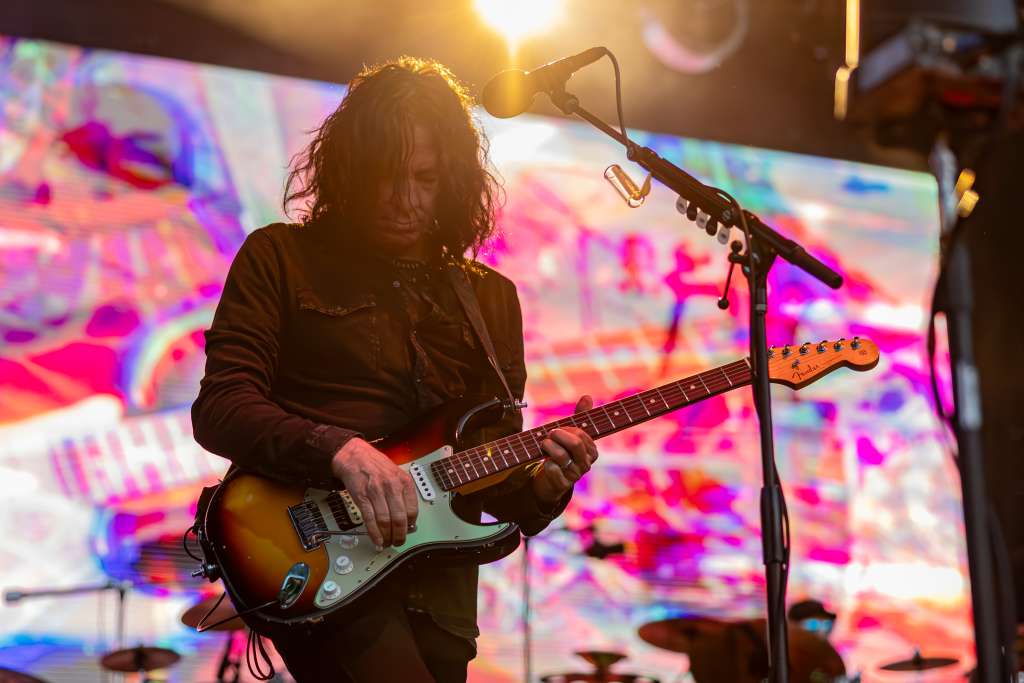
“Harold of the Rocks” gave the night one of its deeper-rooted jolts, a reminder of how early Primus already sounded fully diseased in the best possible way. “My Name Is Mud” hit with the blunt-force recognition of a song that has become bigger than a fan favorite, a kind of communal reflex. When that groove dropped, The Salt Shed moved like somebody had pulled a lever underneath the concrete. Elsewhere, the set dug into the band’s weirder corridors, where deep cuts stretched their legs, mutated into jam-session detours, and reminded everyone that Primus songs are less preserved artifacts than live specimens with bad posture.
That is the thing about Primus. The absurdity is never weightless. Beneath the helmets, the strange instrumentation, the lyrical grotesques, the carnival-barker timing, there is always muscle. There is always discipline. You can laugh at it, but you cannot dismiss it. The band has spent decades proving that ridiculousness can be a serious art form when the players are sharp enough to make nonsense hit with force.
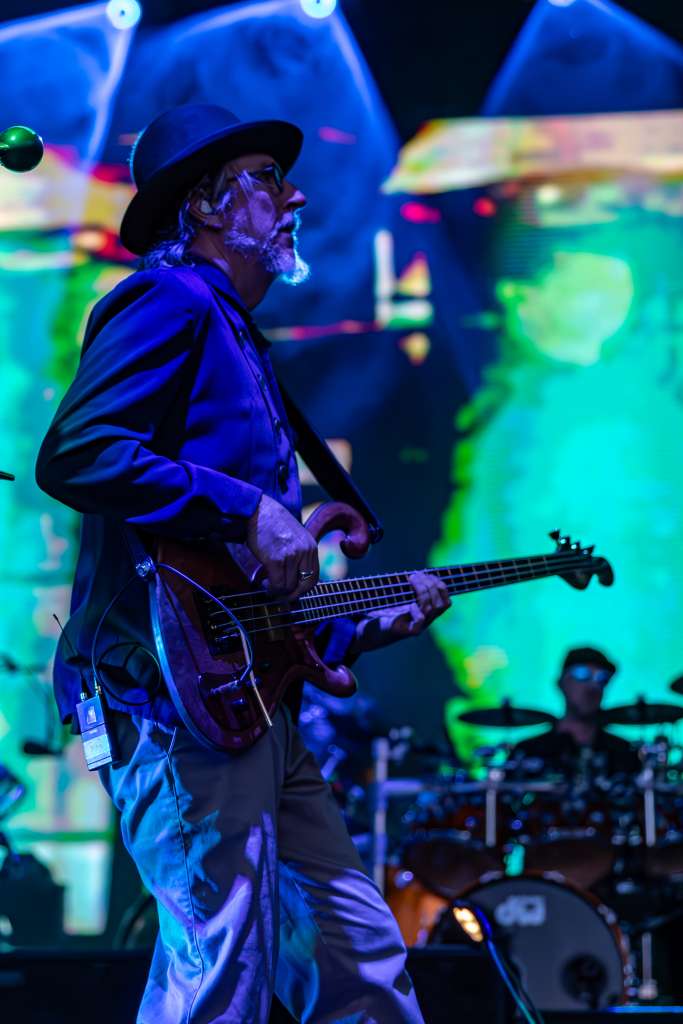
By the encore, the room had already been properly tenderized. “Tommy the Cat” came first, all twitch, swagger, and bass-line acrobatics, the kind of song that turns a crowd into a single grinning nervous system. Claypool did not so much play it as stalk through it, snapping the rhythm into place while the audience followed every crooked turn. It was the right kind of encore bait: familiar, feral, and still strange enough to feel like it had crawled out from behind the amps five minutes earlier.
Then came “Southbound Pachyderm,” and the night widened.
As the final song, it landed differently. Not as another oddity, not as another flex, but as a slow, heavy exhale after all the twitching machinery that came before it. LaLonde pulled out a double-neck Gibson – a visual flourish that could have felt showy in another band’s hands. Here, it looked like the correct tool for a job no normal instrument could survive. Claypool wore a disco ball helmet, a ridiculous and perfect object that turned his head into a spinning shrine to bad ideas, bent light, and bass-driven lunacy. Under the Salt Shed lights, it made him look less like a frontman than the mayor of some underground funk municipality where all laws are written in slap bass.
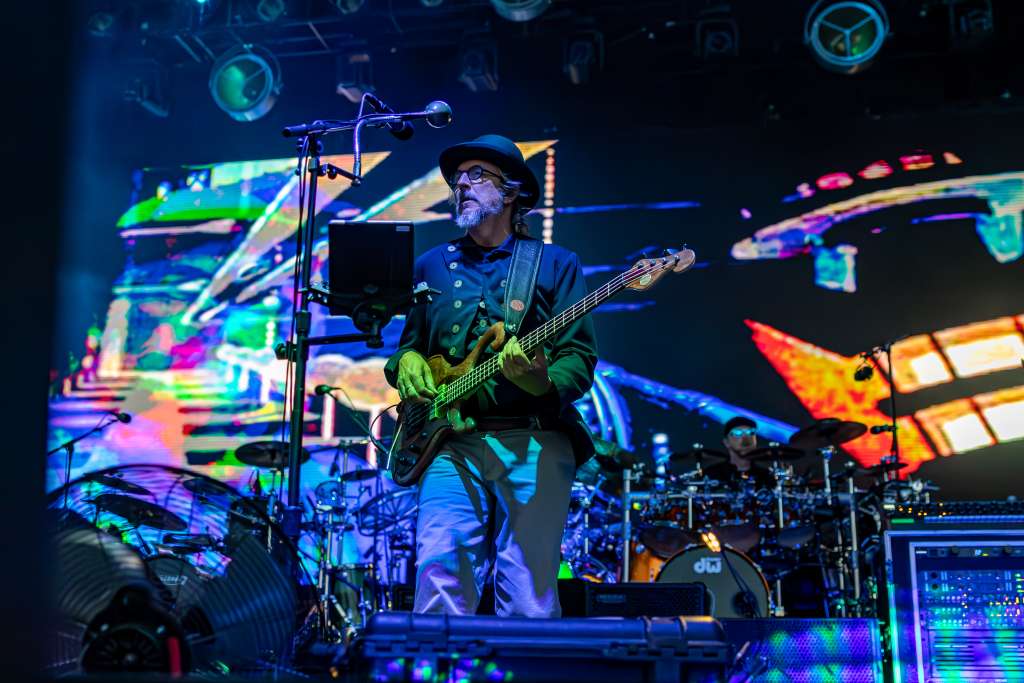
During the breakdown, the room tilted one last time. A xylophone entered the picture, brittle and bright against the swamp-thick low end. Then saxophone. Not as novelty. Not as some cheap “look how weird we are” accessory. It worked because Primus has spent decades making the abnormal feel structural. The xylophone pinged through the groove like bones on tile. The saxophone came in with heat and brass, dragging a different kind of human breath into the machinery. For a few minutes, The Salt Shed felt less like a venue than a deranged workshop where every object had become percussion, every note had developed a facial expression, and every person in the crowd had agreed to stop asking why. They just followed Claypool deep into the weeds and somehow come out happier for it.
The Salt Shed crowd understood the weight of that ending. You could feel the loyalty in the room, not as nostalgia exactly, but as recognition. Primus is history now, whether they want to wear that coat or not. They come from an era when alternative music still had room for dangerous mutations, when weird bands could become household names without sanding off every wart. But they did not play like museum pieces. They played like a machine still chewing through its own blueprint.
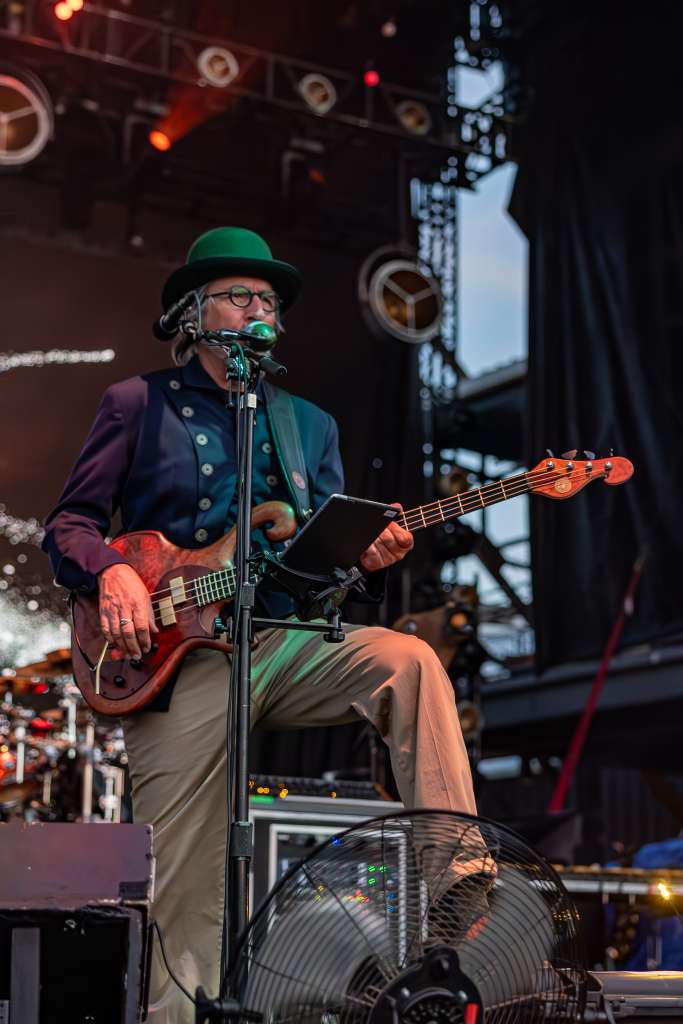
Claypool’s presence carried the night’s emotional peak, though he would probably make a face at that phrasing. There is something oddly moving about watching him cycle through these different musical bodies in one evening: the missed Frog Brigade shadow, the Delirium’s psychedelic sprawl, Primus’ crooked empire. It becomes clear that this is not just a set of projects. It is an ecosystem. One strange brain growing different limbs for different weather.
By the end of “Southbound Pachyderm,” The Salt Shed no longer felt like the place people had fought to reach. The parking nightmare, the construction, the missed opener, the stink of strawberry vape, all of it had been fed into the same grinder. The night converted irritation into sweat, sweat into rhythm, rhythm into shared disbelief.
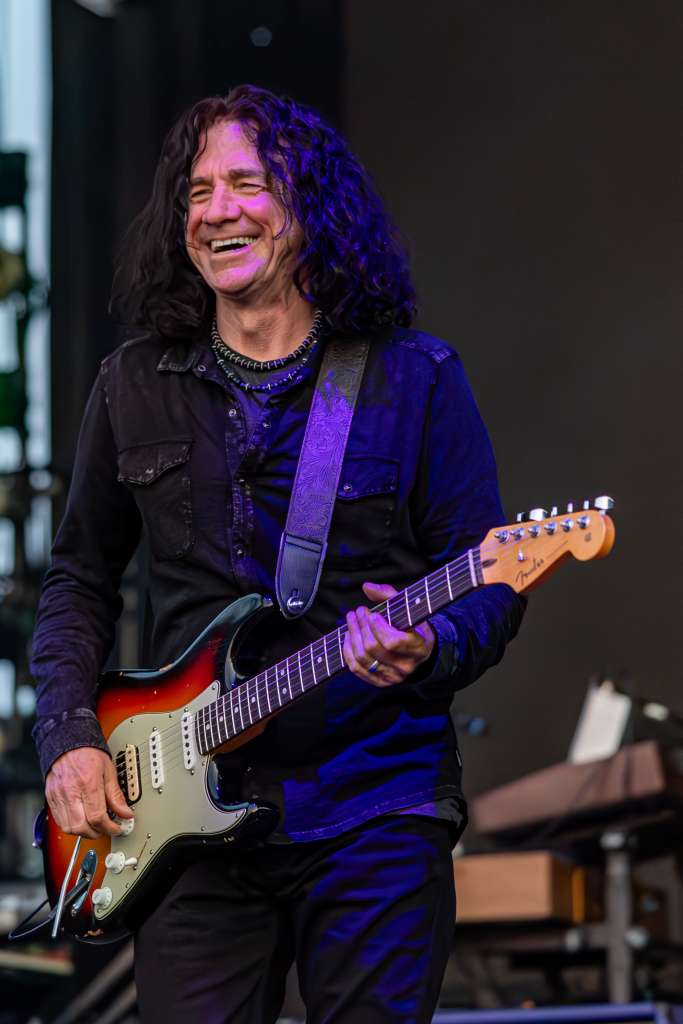
This was a Chicago night in the most honest sense: obstructed, loud, funny, grimy, occasionally maddening, and finally worth the trouble. The Salt Shed became a pressure valve for everyone who had cursed their way through Elston-adjacent congestion just to stand under the lights and watch Les Claypool turn bass into architecture. The missed Frog Brigade set stayed there, a little ghost at the edge of the evening, but it did not define the night. The night belonged to the strange machinery that followed.
The Claypool Lennon Delirium opened the door sideways. Primus kicked the hinges into another dimension.
And somewhere in the middle of it all, under a disco ball helmet, through double-neck guitar flash, xylophone clatter, saxophone heat, and the communal stink of a crowd fully surrendered, The Salt Shed stopped being a venue and became what Primus has always needed: a big industrial body willing to be made ridiculous, rattled from the inside, and sent limping happily back into the Chicago night.