Review by Rick Eaglestone
Some albums are born easy, and some are dragged into the world kicking and screaming, and Dusk… And Her Embrace belongs firmly in the second camp.
By the time it arrived in the autumn of 1996, Cradle Of Filth had already survived a bitter legal war with their first label, the loss of most of their line-up and a recording that had to be scrapped and started again from scratch. On paper, which should have been the end of them. Instead, it became the record that turned a cult Suffolk band into one of the most talked-about names in extreme music, and the moment British black metal stopped looking to Scandinavia for permission. Gothic, theatrical, hideously fast, and unashamedly romantic, it took the raw ingredients of the second wave and drenched them in Hammer horror, Victorian melodrama, and local witch-lore, and in doing so it gave a whole generation of bands a new vocabulary. Thirty years on, Music For Nations is marking the anniversary with a reissue arriving on 30 October across a range of limited and collectors’ formats, and it feels like the right moment to step back into the candlelight and ask why this record still casts such a long shadow.
It is easy to forget just how strange and divisive Cradle Of Filth seemed in the mid-nineties. Britain’s heavy underground was dominated by the gothic doom of the so-called Peaceville Three, Paradise Lost, My Dying Bride and Anathema, all dealing in slow, mournful grandeur, while Norway’s second wave had made black metal synonymous with church burnings, corpse paint, and lo-fi production. Cradle Of Filth fitted neatly into neither camp. They were too fast and too extreme for the doom crowd, too theatrical and too fond of keyboards for the purists, and they took a perverse delight in annoying both. That outsider status, which might have sunk a less stubborn band, became their greatest strength, and this album is where it crystallised.
To understand why Dusk… And Her Embrace mattered so much, you have to go back to the chaos that preceded it. Cradle Of Filth formed in Suffolk in 1991, with Dani Filth the one constant through a revolving door of musicians, and after a string of demos and a lost album called Goetia, which disappeared when Tombstone Records folded, they signed to Cacophonous Records. The Principle Of Evil Made Flesh followed in February 1994, a raw, ambitious debut that announced a band with far bigger ideas than their budget allowed. The relationship with the label soured quickly, however, with the band alleging the label had mishandled both the contract and the money, and much of 1995 was lost to lawyers. A first attempt at the second album was recorded that year, still under the Cacophonous contract, but the band fractured before it could see the light of day. Guitarists Paul Allender and Paul Ryan and keyboardist Benjamin Ryan left during 1995 to form The Blood Divine in Colchester with former Anathema vocalist Darren White, drummer Jon Kennedy also departed, and the recordings were shelved. For most bands, losing four members and an entire album in such a short space of time would have been fatal. Freedom came at a price: one more release for Cacophonous, the V Empire EP, issued in April 1996, before the band could finally sign to Music For Nations and start again.
That brings us to the reissue itself. Music For Nations is presenting the album on standard CD and across a spread of vinyl variants, including black, silver, white, transparent green and splatter pressings (the latter offered through the band’s own store with a signed art print, now sold out), a picture disc and a ‘liquid’ vinyl edition limited to just 100 copies. The core sequence is the original nine tracks, split across two sides on vinyl, but the real prize for completists is the coffin-shaped 2CD boxset, which restores the Slayer cover Hell Awaits and the instrumental Carmilla’s Masque, the two bonus tracks that padded out some earlier editions. A separate coffin-shaped vinyl single pairs Carmilla’s Masque with The Graveyard By Moonlight. Nocturnal Supremacy ’96, from the old leather digibook, has not been mentioned, and nor has any remastering or remixing been credited. This is, as far as anyone can tell, the album as it was, presented in fresh clothes for a new generation of collectors. Dani Filth has been refreshingly candid about the motivation, telling Metal Injection earlier this year that “Sony owned Music for Nations and wanted to reissue it.” There is a pleasing symmetry in that. Founded by Martin Hooker in 1983, Music For Nations was the British home of early Metallica and Megadeth, later operating as part of the Zomba group before being wound down in 2004, and its revival under Sony in 2015 has seen it return to its catalogue with real care. Bringing this album back under the label that first released it feels entirely appropriate.
The album’s identity was shaped as much by its themes as its sound. Filth has spoken of the record reflecting the band’s sense of isolation from the European black metal scene, and rather than imitating the corpse-painted orthodoxy of Norway, Cradle Of Filth turned inward to their own island. British horror, from the lurid gothic of the Hammer films to older Victorian gothic fiction, sits alongside the folklore and witch-lore of their native Suffolk, and the result is a record that feels steeped in candle wax and graveyard soil rather than forest frost. There is something distinctly English about it, too: the flat, haunted landscape of East Anglia, its churchyards and its centuries-old tales of witchcraft, run through the album like a damp mist, and that sense of place gave Cradle Of Filth an identity no amount of Scandinavian imitation ever could. Sheridan Le Fanu’s 1872 vampire novella Carmilla, nodded to by the title of that bonus instrumental, belongs to exactly the tradition the album draws on, with its imagery of seduction and predation, and the whole thing has a decadent, vampiric glamour that set it apart from almost everything else in extreme metal at the time.
It is also worth remembering that there are, in effect, two versions of this album. The shelved 1995 Cacophonous recordings, made with the departed Allender and the Ryan brothers, finally surfaced in 2016 as Dusk… And Her Embrace – The Original Sin. Filth has described that earlier version as “something we attempted beforehand, before the band fractured into two,” and comparing the two is a fascinating exercise. The original sin is rawer and more primitive, the 1996 version more confident, more polished, and far more theatrical. It is the latter that changed things, and it is the latter that this reissue celebrates. The Original Sin appeared on CD and digital in July 2016, followed that October by a vinyl edition limited, inevitably, to 666 copies, and anyone wanting the full picture of how this record came to be would do well to hear both.
Humana Inspired To Nightmare opens proceedings, drawing back the velvet curtain and invites the listener into the gloom. Cradle Of Filth have always understood the value of a grand entrance, and this short prelude establishes the cinematic, horror-movie atmosphere that runs through the entire record. It is a mood piece rather than a song, but its job is to make what follows hit harder, and it does so admirably. For anyone hearing the album for the first time in 1996, it must have felt like the opening titles of a film nobody had quite seen before.
Heaven Torn Asunder duly obliges is the first full-blooded statement of intent, and three decades on it is still one of the songs the band return to night after night. This is where the new line-up announces itself, Barker’s drumming a blur of controlled violence, Anstis’ guitars weaving melody through the chaos and Gregori’s keyboards adding the gothic grandeur that would become the band’s calling card. Above it all, Dani Filth delivers a performance of extraordinary range, from glass-shattering shrieks to guttural snarls, and it is easy to hear why so many listeners were left both thrilled and slightly terrified. Thirty years on, it still sounds like a band throwing everything they have at the wall, and almost all of it sticks.
Funeral In Carpathia is, for many fans, the album’s defining moment. Named for the mountain range forever associated with vampire legend, it is a sweeping, multi-part epic that moves from breakneck aggression to passages of dark, brooding atmosphere and back again. It has never really left the setlist, and it is not hard to see why: few songs in the band’s catalogue capture their blend of speed, melody, and theatre quite so completely. The title, with its echoes of Stoker and the old Hammer films, is a perfect summary of the album’s world: remote, dangerous, and drenched in gothic romance.
A Gothic Romance (Red Roses For The Devil’s Whore) title alone tells you everything about the band’s aesthetic at the time: lurid, decadent and unashamedly over the top. It is another song the band rarely leave out live, and it captures the album’s sense of seduction, with female backing vocals becoming an increasingly important part of the band’s sound on this record. Romance and horror were never far apart in Cradle Of Filth’s world, and this is where the two intertwine most completely.
Malice Through The Looking Glass, the sly twist on Lewis Carroll that hints at the band’s literary bent and taste for wordplay. Coming after the double epic of Funeral In Carpathia and A Gothic Romance, it tightens the focus, a more compact and direct burst of venom that keeps the album’s momentum surging forward. It may be one of the less celebrated songs on the record, but it is a reminder that the band could be economical when they chose to be.
Dusk And Her Embrace, the title track, is the album’s heart distils everything the record stands for into a single song, and it remains one of the fixtures of the band’s live show to this day. There is a sense of yearning and seduction here that sits alongside the aggression, a reminder that this album was never simply about speed and shock, but about atmosphere and storytelling. If you only play one track to explain what made this record special, this is the one. That it has survived three decades of setlists, line-up changes and shifts in fashion says everything about its quality.
The Graveyard By Moonlight, a moonlit interlude that gives the listener a moment to catch their breath before the final stretch. Like Humana Inspired To Nightmare, it is more about mood than muscle, but on an album this intense, its role in the pacing is vital. It is the calm in the eye of the storm, and a reminder of how carefully the record was sequenced. Placed between the title track and the closing pair of long songs, it acts like an intermission, the lights dimming before the last act begins.
Beauty Slept In Sodom brings the darkness back with a vengeance is another expansive piece, steeped in biblical decadence and gothic menace, and it showcases the band at their most ambitious, layering keyboards, guitars, and vocals into something that feels almost orchestral. It may not have the profile of the album’s bigger live favourites, but for many long-term fans it is one of the record’s hidden gems. It is also a fine showcase for Barker, whose drumming throughout the album remains a masterclass in speed married to precision.
Haunted Shores closes the album carries a special significance thanks to the presence of Cronos. Having one of the founding fathers of black metal lend his voice to the final track was both a statement of lineage and a seal of approval, linking Cradle Of Filth directly to the genre’s roots while they were busy reinventing its future. It is a fitting finale, grand and haunting in equal measure, and it brings the album full circle, from the opening curtain to a final, lingering farewell. There is something poetic about a record so determined to forge its own path ending with a nod to the band that started it all.
What stands out, revisiting Dusk… And Her Embrace as a whole, is how complete it feels. There is very little filler, the sequencing flows superbly between epics and interludes, and the balance between aggression and atmosphere gives the record a texture that few of its peers could match. Barker’s drumming remains astonishing, Anstis and Gregori give the music its melodic and symphonic depth, and Dani Filth sounds like a man who has found exactly what he was looking for. His vocal performance deserves particular mention. Few singers in extreme metal have ever covered quite so much ground in a single song, let alone a whole album, lurching from banshee shrieks to bestial growls and theatrical whispers, often within the same line, and it is a voice that divided opinion then just as it does now. Love it or loathe it, nobody else sounded like this in 1996, and the sheer audacity of the performance is a large part of why the album made such an impact. It is also striking how well the album has aged. Its preoccupations with vampires, decadence, death, and doomed romance have never gone out of fashion in heavy music, and the literary, slightly mischievous intelligence of the lyrics stops it ever tipping into cliché.
Anyone who already owns the album on CD or vinyl will find no new music here beyond the two bonus tracks reinstated on the coffin set, and without an announced remaster, the appeal is largely for collectors and newcomers. Plenty of fans have grown up with this record without ever owning a physical copy, and for a new generation who discovered Cradle Of Filth through later albums, a fresh pressing is the easiest way to experience where it all began. The coffin boxset, coffin single and picture disc are clearly aimed at the faithful, and the band know their audience well enough to understand there is real demand. Some will inevitably wish for more, whether a fresh remaster, a fuller disc of rarities or the 1995 recordings packaged alongside the finished album, and it is fair to say that a thirtieth anniversary could have justified a more lavish treatment. But as a straightforward celebration of a landmark record, it does what it sets out to do. Sometimes the simplest approach is the right one, and letting the original album speak for itself is no bad thing.
There is also a wider context worth considering. Cradle Of Filth are in a busy phase of their long career. The Screaming Of The Valkyries arrived in March 2025, and Dani Filth has said a new album has already been written, with the band reportedly reuniting with producer Scott Atkins at Grindstone Studios in Suffolk. This reissue also follows the re-release of the 1999 EP From The Cradle To Enslave earlier this year, suggesting a band and label keen to give the back catalogue the attention it deserves. Revisiting Dusk… And Her Embrace now, three decades after it changed everything, feels less like nostalgia and more like a reminder of the foundations on which everything since has been built. It was this album that led directly to Cruelty And The Beast in 1998, and without it, the band’s later success, from Midian to Nymphetamine and beyond, is hard to imagine.
Ultimately, the songs themselves are beyond question. Dusk… And Her Embrace was the album that rescued Cradle Of Filth from collapse, redefined what British extreme metal could be and laid the groundwork for one of the most successful careers in the genre. Thirty years on, it has a strong claim to being the finest record the band have ever made, and any excuse to revisit it, whether on silver vinyl, in a coffin or on a picture disc, is a welcome one. Its fingerprints are all over the symphonic and gothic extreme metal that followed, and its blend of horror, romance and sheer velocity still sounds remarkably fresh. For long-term fans, this reissue is a chance to own a favourite in a new guise; for newcomers, it is the perfect place to start, the moment when a band from rural Suffolk found their voice and refused to be ignored. Light the candles, draw the curtains and let the dusk embrace you once more.
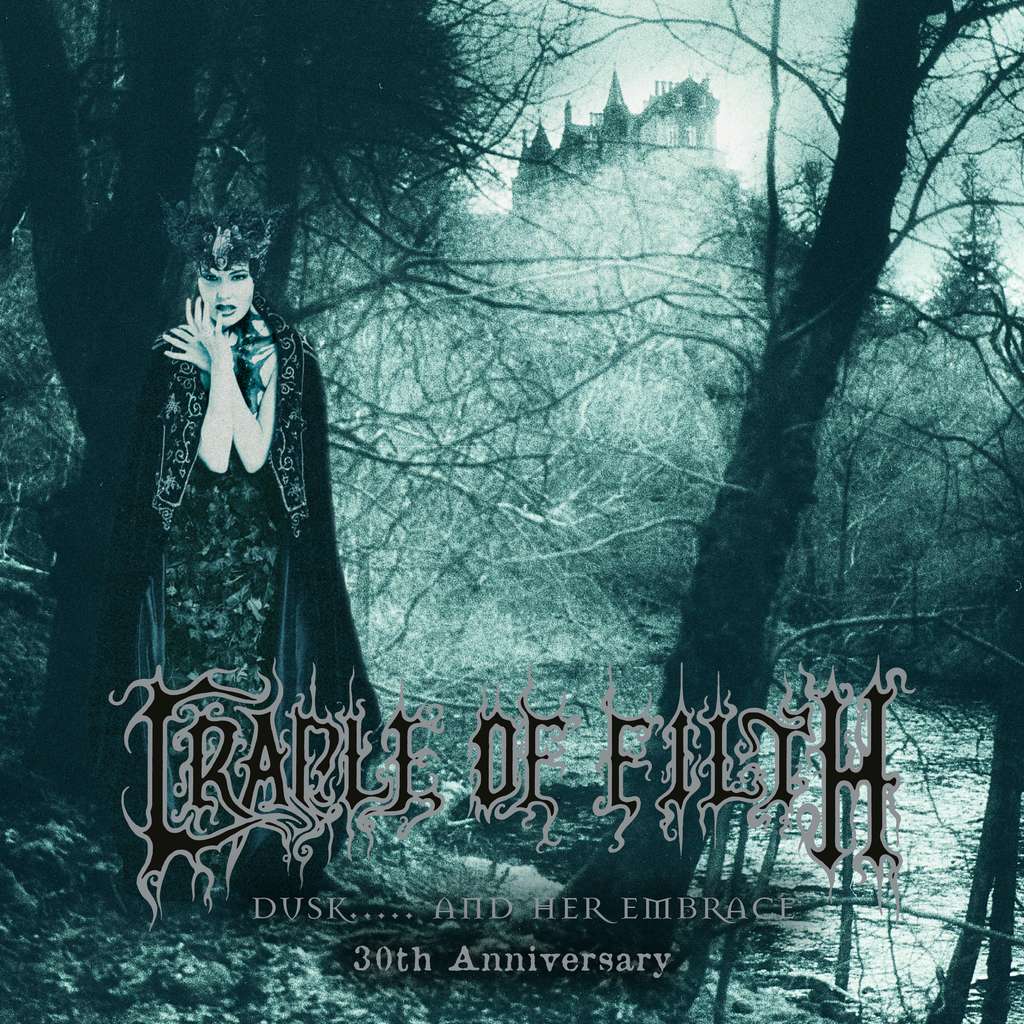
Dusk… And Her Embrace (30th Anniversary) – Track listing:
1. Humana Inspired To Nightmare
2. Heaven Torn Asunder
3. Funeral In Carpathia
4. A Gothic Romance (Red Roses For The Devil’s Whore)
5. Malice Through The Looking Glass
6. Dusk And Her Embrace
7. The Graveyard By Moonlight
8. Beauty Slept In Sodom
9. Haunted Shores
Bonus tracks (coffin-shaped 2CD boxset):
Hell Awaits (Slayer cover)
Carmilla’s Masque
Coffin-shaped vinyl single:
A. Carmilla’s Masque
B. The Graveyard By Moonlight
Line-up
Dani Filth – Vocals
Gian Pyres – Guitars (credited)
Stuart Anstis – Guitars
Robin Graves – Bass
Damien Gregori – Keyboards
Nicholas Barker – Drums
Website:
Spotify:
Instagram:
https://www.instagram.com/cradleoffilth
Facebook:
https://www.facebook.com/cradleoffilth
X:
9/10