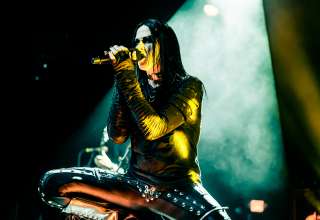

Review & Photography by Manny Manson for MPM
There’s nothing quite like getting stuck on a smart motorway, crawling along the M1 while the sun’s dropping and you’re desperately trying to get to a gig on time.
It’s like the world knew TERRORVISION, (supporting American rock giants EXTREME,) were playing The Piece Hall and wanted to delay me just to see if I’d miss it. But credit where it’s due, Halifax had its act together. The parking was solid, the staff were friendly, and getting into the venue was so smooth it felt suspicious. One of those rare moments where everything just worked. Which was a relief, because I arrived to be told that my accreditation was just for TERRORVISION, and so with about three seconds to spare and no time for overpriced lager or a toilet trip it was straight in, the sun still lingering, and there they were, TERRORVISION, the pride of Bradford, right in the middle of Yorkshire’s poshest courtyard.
TERRORVISION have always been about a celebration of chaos and colour and catchy-as-hell tunes. Formed in 1987 in Bradford under the name The Spoilt Bratz before changing to TERRORVISION in 1991, they exploded onto the scene with Formaldehyde in 1993, a record that hinted at what was to come but didn’t quite prepare the world for the hooks and humour that would define them. The follow-up, How to Make Friends and Influence People in 1994, was their real breakout – an album stuffed to the rafters with pop-metal anthems and cheeky swagger. Regular Urban Survivors followed in 1996, then Shaving Peaches in 1998, with Good to Go rounding out their original run in 2001.

They called it a day, as bands often do, but never for long – reformations followed, and so did gigs, and now, in 2025, here we are again, watching these hometown heroes tear the roof off a building that doesn’t even have one. kicking off with “Discotheque Wreck” like they were trying to knock down the walls.

It’s hard to think of a more perfect opener, all distorted vocals and crunchy guitars, a call to arms wrapped in a glorious mess of punky glam. It’s that shouty, stomping anthem from 1994’s How to Make Friends and Influence People hit like a tin of lager to the back of the head, messy, chaotic, and completely welcome. The sound bounced off the old stone like it had been waiting for years. Tony Wright was on full Duracell bunny mode from the off, bouncing around the stage, flailing arms, grinning like a madman who’d just found his old VHS collection. Bassist Leigh Marklew was pogoing about, pulling faces at the crowd like a man possessed, while guitarist Mark Yates flung his low-hanging Les Paul around like it owed him money.

The kick drum was sharp enough to cut through the pint buzz, and somewhere behind the amps were a trumpet and a sax player, just about visible but clearly blasting their guts out. Lurking behind his keys, like some mad scientist rocked out Milton Evans, totally commited with one-foot permananetly perched a top of a monitor, he surveyed the crowd as conjured up spells on the keys, swirls and wobbles gluing the chaos together he seemed like a mad man possessed by the ghost of Rick Wakeman at a student rave. The whole thing was set against this big bright blue backdrop with “We Are Not Robots” scrawled under the band logo, just in case anyone thought this might be a slick, pre-programmed kind of night. It really, really wasn’t.

Straight into “Perseverance” next, from 1996’s Regular Urban Survivors, and it’s impossible not to scream “Whales and dolphins!” when that chorus drops. It’s muscle memory at this point. Still one of their biggest songs, and it still sounds like a brass-fuelled sugar rush – punky energy shot through with weird optimism. The crowd was bouncing like someone had handed out free space hoppers. Tony was tearing around the stage like it was a school sports day and he was in every race. And that chorus… it hits different when you’re shouting it with 3,000 other people.

Then “My House”, originally from 1993’s Formaldehyde, though it’s probably best known from its re-release just before How to Make Friends made them massive. It’s always been that early signature tune, with that stomping beat and madcap energy. Tony screamed every line like he’d just had his telly repossessed, and the crowd yelled back like it was the gospel. That slightly off-kilter groove still works wonders live – nothing fancy, just big dumb fun. The kind of song that makes you forget rent and broken phones and lean into the daftness.

“Celebrity Hit List” came in snarling next, a standout from Regular Urban Survivors. There’s always been something a bit theatrical about that tune – like it wants to be in a musical where the cast all wear leopard print. The song’s got this wild, almost cabaret-style sneer to it, a satirical slice of fame culture that’s somehow more relevant now than when it first dropped in the mid-90s. Tonight, it swaggered in with full brass behind it and Tony giving full panto energy. Yates looked like he’d emerged from the back of a dry ice machine, flinging out slinky riffs while Marklew looked like he was trying to scare someone in the front row with his eyebrows. It was glorious. “American TV” goes all the way back to Formaldehyde and still sounds sharp and sarcastic as ever. That jerky rhythm and almost-funky edge gave it this weird sense of groove.

There’s almost a punk-funk heartbeat to it, driven home by the tightly locked rhythm section and storming backing horns, there’s something about the way the horns punch in over the top, like late-night cable channel static. It’s still got that fuzzy, offbeat charm. Meanwhile, the keyboardist, one foot still on the speaker stand, rocking like he was in a YES tribute band, absolutely went for it, filling in all the cracks like some sort of musical Polyfilla, totally in his own world, but without him, it wouldn’t have sounded half as big.

Then came “If I Was You”, from 2001’s Good to Go, one of the less-played singles but a belter live. It’s a darker, groovier number, not as instantly catchy, It’s got a more mature edge, still with that snarl but wrapped in a slightly darker, moodier coat, that snarl, by the way, lands hard. Chris Bussey laid down a tight, no-nonsense drum groove, and the rest of the band rode it like they’d nicked it from Queens of the Stone Age. A real sleeper hit, that one, came out slick, sharp, and snarling. Then bang, back into chaos with “Alice, What’s the Matter?”, back to How to Make Friends, and the place kicked off again. It’s never not fun live. That riff is like a pan falling down stairs, the lyrics are pure manic ramble, and the whole band looked like they were trying to one-up each other on who could flail the hardest. Tony might’ve covered every inch of the stage in 90 seconds, Yates played like his strings were on fire, and Marklew was practically doing parkour around the monitors. YES, this one’s still pure unfiltered chaos, screechy, sludgy riffs layered with vocals spat out like bullets, and the whole band throwing themselves into it with gleeful violence. Whats not to like!

“Josephine”, changed the tone slightly, a surprisingly emotional track from 1998’s Shaving Peaches, was a lovely little breather, not slow, exactly, but it’s got that weird off-centre romantic thing about it. And with that the crowd swayed. You could see arms around shoulders, people singing it like it was their uni ballad. The horns gave it this warm hum and the drums sat back just enough. The chaos dipped, just for a moment, and you got this strange wave of sentiment. Then, inevitably, they blew the doors off again. “D’Ya Wanna Go Faster?” quickly followed, also from Shaving Peaches, kicked us straight back into party mode, and it basically answered its own question. Yes. We did. It’s got disco, punk, rock vibes, glitter on the boots and sludge on the riff. The chorus is like being dared to keep up. And somehow, even though they’ve been playing for the better part of an hour, nobody on stage or in the crowd had slowed down.

Then they dropped “The Night That Lemmy Died”, a more recent track, likely from their We Are Not Robots material, and it landed like a tribute and a celebration all at once. None of that slow, mopey, over-sincere stuff, it was driving, loud, and full of love. The horns soared, and everyone just nodded in solidarity. It’s not just a love letter to Lemmy, it’s a love letter to every band, every fan, every sweaty club where the volume’s a little too high and the beer’s always warm. And as Yates ripped into a filthy solo, Wright belted out the lyrics so they hit us square in the guts, Lemmy would’ve raised a glass. So I did, Cheers!

“Some People Say” is another from How to Make Friends, and it still has that underdog anthem feel, all scratchy guitars, off-beat vocals, and defiant charm. It’s one of those songs that lives and breathes better live. It harks back to their earlier days oncemore, it still sounds raw and fierce. That rough-around-the-edges production from the studio somehow comes to life live, and in this setting, under the stone arches and open skies, it was pure magic. The band tore through it like it had only just been written. Then came “Baby Blue”, again from How To Make Friends, all shimmering in like some kind of weirdly romantic punk ballad, all slow groove and odd tenderness. It’s the kind of track that makes you realise how weirdly diverse this band really are, all without ever losing the thread of who they are. Slower, soulful, with a grooving little backbone and loads of space for the brass to shine. It had this weirdly hypnotic swing, the kind that catches you off guard and makes you drift for a second, arms in the air, smiling at strangers. That’s the joy of these lad’s, they throw these left-turns in that still make total sense in the middle of the madness.

Then the crowd erupted because it was time. “Tequila.” It was inevitable, and we’d been waiting for it. That song, from Shaving Peaches, their biggest chart success, is still one of the most ridiculous and brilliant pop-rock anthems of the ’90s. Every single person in the Piece Hall screamed the chorus like their lives depended on it. Tony strutted around like a victorious wrestler, and the band leaned into every second of it, horns blasting like sirens and basslines wobbling through our knees. The ridiculous, glorious, unavoidable juggernaut that it is. If anyone in that courtyard wasn’t shouting “Tequila!” at the top of their lungs, they were probably dead. Tony milked every second, Marklew was spinning like he’d lost control of his legs, and the trumpet player went full Vegas showman despite being barely visible. It was stupid and perfect and everything it needed to be.

“Shine On” came in next – another How to Make Friends beauty, it took us right back to the earlier years again, that jagged riff and pulsing beat setting up a chorus that soared, Marklew again leaping about like a man with springs in his knees. It still feels like their most oddly uplifting track. That chorus, that choppy rhythm, the slight bounce. It’s like someone distilled joy into four minutes and threw it at a sound system.
“Middleman” – also from How to Make Friends – kept it tense, tight, and tuneful. Proper pacing, a bit of grit, a nice gritty growl from Tony and those locked-in guitars and bass. It was raw and biting, a reminder of how tight their songwriting always was, lyrics that dig, rhythms that punch. The whole thing had this boiling intensity, a build and break and build again, with Chris Bussey smashing the drums like a man with a vendetta. You could feel the crowd getting breathing as one as they bounced along, nobody was giving up, they were in it for the long term.

Then “Pretend Best Friend” was a riot once more, and everything went ballistic. Another anthem from How to Make Friends, it’s all sarcasm and punch and swagger, and the whole Piece Hall crowd turned into a jumping mass of arms fists and heads, oh and shouted lyrics. The band were grinning like they’d just robbed the place as the entire Piece Hall were jumping in time as Tony whipped them into a frenzy. It’s always been one of their most anthemic songs, all sass and sarcasm and stabbing melody, and here it felt like a riot in the best possible sense.
Then finally, “Oblivion”. Of course. The one. The closer. Their biggest hit, the don’t-you-dare-leave-it-out monster. From How to Make Friends, and still sounding massive. That chorus hit like a tidal wave, the horns blasted like air raid sirens, and everyone screamed “na-na-na-na” like it was their birthright. Tony stood there with his arms wide, Yates wrung the neck of that Les Paul like he was starting a fire with it, and the backdrop glowed in the blue haze of lights and smoke. There couldn’t have been a better ending. It’s still got that perfectly crafted mix of glam and grit, of humour and hurt, and when that chorus hits, it’s like every single person in the audience becomes one big lung belting it back to the stage. The lights hit full brightness, the backdrop glowed like a beacon, and there it was, the purest expression of what this band is about. Fun. Energy. Love. Madness.

And then it was done. No fuss. No long-winded goodbye. Just sweat, noise, and the lingering scent of chips and cider. You could hear snatches of songs being hummed, shouted, argued about. People singing “Tequila”. Strangers high-fiving. The kind of post-set buzz you wish you could bottle and sell as cologne.
TERRORVISION don’t do sleek. They don’t do subtle. They don’t do boring. What they do is throw a party that punches you in the face, hugs you afterwards, and makes you want to do it all over again the next night. And on a summer night like this, in a place like this, it didn’t feel like a gig. It felt like a homecoming. A celebration. And probably the most fun you can have in Halifax without being arrested.