
Review & Photography by Manny Manson for MPM
As the final reverberations of “Aurea” hung in the air, the stage fell into darkness. For a few fleeting moments, the O2 Institute felt like it was holding its breath. The Black Spikes gear was carefully cleared, cables pulled, pedals stacked, drum kit adjusted, but the energy they had conjured lingered like a tangible pulse vibrating through the floorboards. You could sense the anticipation ratcheting up, a collective inhale from the crowd, knowing something entirely different, something wilder, was about to hit. The lights shifted to a harsher, colder hue, metal glinting off mic stands and cymbals, and for a heartbeat, the room felt expectant, charged with the knowledge that a storm was coming.

Then Butcher Babies exploded into view. Heidi Shepherd stood front and centre, immediately commanding the room with that raw, magnetic intensity she has perfected since the band formed in Los Angeles in 2010. Henry Flury crouched over his guitar, every finger on the fretboard ready to slice through the tension, Ricky Bonanza’s bass growled low and steady beneath Dave Nickles’ punchy, precise drum attacks. Gone was the ritualistic atmosphere of Black Spikes; this was confrontation, adrenaline, a visceral jolt of metal and groove. The Digbeth floor rippled under the surge of bodies as the first notes of “Backstreets of Tennessee” (Goliath, 2013) hit.
“Backstreets of Tennessee” didn’t ease anyone in, it grabbed the crowd by the collar and refused to let go. The opening riff, thick and distorted, immediately set the tone: Southern swagger twisted into metallic ferocity. Henry Flury’s guitar tone was razor-sharp, every palm-muted run punctuated by open-string accents that cut through the mix, while Ricky Bonanza’s bass grounded the groove with a chunky, resonant thrum, low-end rumbles shaking the chest of anyone nearby. Dave Nickles’ drumming was precise but explosive, kick patterns syncing with the guitars, snare cracks cutting like a whip through the air.

Heidi owned the room vocally, alternating between controlled melodic bursts and unflinching screams that clawed over the instrumentation. Each line was delivered with intent, drawing the crowd in, eyes locking, shoulders bouncing. The Digbeth audience responded instantly, fists raised, heads nodding in unison. This wasn’t just a song, it was a declaration, a statement that the night had just shifted gears entirely.
The verses breathed just enough space for dynamics to swell, before collapsing into choruses that hit like a hammer. Henry and Heidi played off each other in subtle ways—guitar accents punctuating vocal inflections, momentary pauses that let Heidi’s voice dominate and then suddenly explode back into full-band intensity. The song built, tightened, and then landed with the final, screaming chorus, leaving the crowd in a collective frenzy before Butcher Babies launched straight into “Red Thunder” (Take It Like a Man, 2015).
“Red Thunder” hit like a lightning bolt, immediately sharpening the energy in the O2 Institute. Where “Backstreets of Tennessee” had built tension and swagger, this track tore into the crowd with precision, speed, and absolute intent. Henry Flury’s guitar work was razor-edged, every palm-muted run and open-string accent sliced cleanly through the room, yet he tempered it with subtle slides and vibrato that gave the riffs depth, not just aggression. Ricky Bonanza’s bass locked perfectly with Dave Nickles’ drums, the kick and snare driving the pulse while occasional tom fills punctuated the track’s rhythmic complexity, giving the groove a rolling momentum that kept the pit in constant motion.

Heidi Shepherd’s vocals were a masterclass in controlled intensity. The opening lines were delivered with a low, snarling bite, dragging syllables behind the beat to give them weight before snapping into high, sharp screams that cut through the thick instrumentation. Every note felt intentional, she wasn’t just shouting, she was commanding the room. Her presence was magnetic; she prowled the stage like a predator, leaning close to audience members at the barrier, letting her gaze and energy draw them into the performance rather than merely observe it.
The chorus hit like a tidal wave. Heidi’s voice soared above Henry’s shredding leads and Ricky’s pulsing bass, while Dave’s snare snaps and cymbal crashes accentuated the natural drama of each line. The tension between restraint and release in the verses made the chorus explode with impact, forcing bodies to collide in the pit, fists pumping, heads banging, the Digbeth floor vibrating under the collective weight.
Dynamic shifts in the bridge showcased the band’s tightness and cohesion. Henry and Heidi had this unspoken interplay, guitar stabs echoing vocal inflections, quick drops in the instrumentation leaving only the rhythm section and Heidi’s voice hanging in the air, creating moments of suspense before erupting back into full-force metal fury. The live mix allowed every instrument to breathe while giving Heidi room to dominate, her tonal shifts, from growls to piercing highs, slicing through the room without ever feeling chaotic.

By the time the final, relentless riff hit, the pit was fully alive, moving as one, bodies flowing with the band’s every accent. As the last note screamed out, sustained on Henry’s guitar and mirrored by Ricky’s deep bass thrum, the crowd erupted into cheers, not just for the song itself but for the sheer ferocity and precision with which Butcher Babies had delivered it. It wasn’t just a track—it was an assertion, a full-throttle statement that the night had officially escalated.
“Monsters Ball” hit the O2 Institute like a controlled demolition. The opening guitar stabs from Henry Flury were sharp and deliberate, each note cutting like steel, while Ricky Bonanza’s bass rumbled underneath, anchoring the groove with a sinister undertone that made the pit tighten instinctively. Dave Nickles’ drums were a study in precision and chaos coexisting; snare snaps sliced through the air as cymbals crashed with perfect timing, yet his fills were unpredictable, giving the song a sense of barely-contained danger.
Heidi Shepherd prowled the stage like a live wire. From the first lyric, she commanded the room with a mix of theatrical menace and raw charisma, switching fluidly between snarling aggression and melodic clarity. Every gesture, leaning into the crowd, tilting her head to emphasize a line, a finger slicing the air, felt calculated to draw the audience into her orbit. Her vocals carried a narrative weight, each line a story of defiance and fury, and the crowd leaned in, hanging on every syllable.

The song’s dynamics were relentless. The verses, punctuated with stop-start riffs, allowed Henry’s guitar to punctuate Heidi’s delivery with sharp accents and subtle squeals, while the rhythm section kept a taut tension underneath. Then the chorus smashed through, heavy, rolling, unyielding, forcing bodies to collide in the pit, fists pumping, heads banging in unison. You could feel the energy bouncing off the brick walls, amplified by the collective adrenaline of the audience.
Mid-song, the bridge offered a brief, dramatic pause. The guitars dropped to clean, ringing chords, the bass hummed low beneath them, and Heidi’s voice softened for a haunting, almost whispered interlude. In those seconds, the room seemed to inhale collectively, caught in the contrast between delicate tension and explosive release. Then, without warning, the band erupted back into the main riff, a brutal, almost theatrical return that sent the pit into chaos once more.
“Monsters Ball” isn’t just a song, it’s a living performance. Heidi’s every inflection, Henry’s tight and expressive fretwork, Ricky’s grounding growl, and Dave’s unpredictable drum pattern coalesced into a maelstrom of sound that was as much felt in the chest as it was heard through the ears. By the time the final crash echoed into the ceiling, the crowd was left spent, exhilarated, and ready for the next wave of intensity that Butcher Babies had in store.

“Sincerity” hit like a shift in atmosphere, a moment where Butcher Babies showed that intensity doesn’t always have to roar, it can smoulder, drawing the crowd in before the storm breaks. The opening guitar notes from Henry Flury were cleaner, more spacious than the previous tracks, letting each chord ring with clarity. The tone was crisp, articulate, yet threaded with enough grit to remind everyone that this was still Butcher Babies, still dangerous. Ricky Bonanza’s bass hummed just beneath the surface, a steady undercurrent, while Dave Nickles’ drums balanced delicacy and punch, the kick and snare tapping into a rhythm that felt almost hypnotic before erupting into force.
Heidi Shepherd’s vocals were on another level here. She began with a softer, melodic approach, letting the words breathe and curl around the audience, almost intimate despite the raging crowd. Her phrasing was deliberate, with subtle bends and slides that gave the lyrics an emotional weight rarely felt in metal. Then, as the chorus approached, she tore into it, the harsh textures cutting through the clean guitar, her screams threaded seamlessly with her melodic lines, creating tension and release in perfect harmony. Her movements on stage were fluid, leaning into the crowd, tilting her head, every gesture commanding attention, every glance a magnetic pull.

The chorus hit like a wave crashing into the room. Henry’s guitar riffs-built tension, bouncing off the rhythm section’s tightness, while Heidi’s vocals soared, layered with texture, clarity, and bite. The crowd responded instinctively, hands in the air, voices joining hers in the melodic sections, bodies swaying and then breaking into full headbanging as the intensity returned.
Mid-song, the dynamics shifted again. Clean guitar arpeggios intertwined with subtle bass movements, the drums occasionally breaking into syncopated fills, and Heidi’s voice danced between whispered vulnerability and piercing aggression. It was a study in contrast, the calm making the storm hit harder, each scream and riff landing like thunder after a moment of tense quiet.
By the time the final notes rang out, the audience was both mesmerized and drained, fully absorbed in the emotional arc of the song. “Sincerity” isn’t just a track, it’s a demonstration of how Butcher Babies have evolved, blending aggression with nuance, control with chaos, leaving every listener acutely aware of both the power and the precision behind every note and every scream.

“Beaver Cage” hit like a sudden jolt to the system, snapping the room into raw, unrestrained energy. From the first guitar chord, Henry Flury’s tone was jagged and aggressive, a perfect blend of gritty palm-muted riffing and biting open-string accents that pierced the thick air of the O2 Institute. Ricky Bonanza’s bass rumbled low and omnipresent, driving the groove with a sense of urgency, while Dave Nickles’ drumming felt like controlled chaos, hard-hitting, precise, but with just enough swing in the fills to keep it alive, unpredictable, and thrilling. The pit responded instantly, bodies colliding in tight, kinetic waves, a physical manifestation of the track’s abrasive personality.
Heidi Shepherd’s vocals were untamed yet impeccably controlled. She opened with a guttural, snarling tone, each syllable spat out with attitude and precision, before transitioning into higher-pitched, cutting screams that sliced through the instrumentation. Every inflection carried intent—there was anger, confrontation, and dark humour woven together, and the audience could feel it. Her stage presence was magnetic; she stalked the front, leaned into the barrier, challenged the crowd with every movement, making them complicit in the chaos.

The song’s structure was a masterclass in tension and release. Verses tightened the energy with staccato riffs and sparse fills, forcing the pit to coil and react, while the choruses erupted with full-force aggression, layering guitar harmonics over pounding drums and booming bass. The dynamics shifted rapidly, the brief, quiet pauses before the explosive crashes allowed Heidi’s voice to dominate, commanding attention, making every scream and growl land with maximum impact.
Midway, Henry added subtle textures, pinched harmonics and feedback swells that gave the riff a jagged edge without overwhelming it, showing technicality without sacrificing raw power. The rhythm section never let go; every snare snap, kick pulse, and bass line reinforced the chaos, giving the audience something solid to hang onto amidst the frenzy.
By the final breakdown, the entire room had become a living organism, bodies moving as one, hearts pounding in sync with the band. Heidi’s final screams rang out, cutting through the ringing guitars and deep bass, leaving the room spent but electrified. “Beaver Cage” isn’t just aggressive, it’s theatrical, visceral, and fully alive in a live setting, a perfect representation of Butcher Babies’ ability to fuse technical skill with raw, unfiltered energy.
The opening riff of “It’s Killin’ Time Baby” hit like a slap of icy adrenaline, slicing through the O2 Institute’s charged atmosphere. Henry Flury’s guitar was razor-sharp, biting and aggressive, every note executed with tight precision yet dripping with menace, the palm-muted staccato sections locking in perfectly with Ricky Bonanza’s rumbling bass lines. Dave Nickles on drums pushed the pace relentlessly, kick and snare driving a pulse that felt like it could tear the floorboards loose, while his fills landed like sudden shocks, keeping the room on edge.

Heidi Shepherd prowled the stage like a predator. From the first guttural roar, her vocals were feral, oscillating between snarling aggression and piercing, high-register screams. Every syllable was charged with intent, her delivery razor-focused yet brimming with theatrical flair. She stalked the front of the stage, locking eyes with audience members, challenging them, dragging them deeper into the track’s chaotic energy. The room responded instinctively, heads banging, fists pumping, bodies colliding in a pit that seemed to grow with every riff.
The song’s structure was relentless yet layered. The verses, tight and rhythmically punchy, built tension, while the choruses exploded with unrestrained force, Henry’s riffs layering dissonant harmonics over the pounding rhythm section. Midway, the guitars introduced subtle harmonic squeals and feedback swells, adding texture and depth without slowing the merciless momentum. Heidi’s voice rode over it all, unafraid to switch from primal growls to piercing wails, pushing the audience into a collective frenzy.
Even the dynamics were a lesson in controlled chaos. Brief pauses in the riffing allowed Heidi’s voice to dominate, cutting through the instrumentation, commanding absolute attention. The audience hung on every syllable, feeding back into the energy loop, making the performance feel like a shared, almost ritualistic experience.
By the final bars, “It’s Killin’ Time Baby” left the room vibrating with adrenaline. The pit had become a living storm, bodies moving in unison yet unpredictably, a perfect reflection of the track itself. Butcher Babies demonstrated here that aggression isn’t just noise, it’s precision, performance, and connection, and tonight, every note, scream, and drum hit landed like a declaration of intent.

From the opening low-end rumble, “Sleeping with the Enemy” swallowed the O2 Institute whole. The guitars, tuned down and drenched in grit, crawled across the room like a slow-moving predator. Henry Flury’s riffs were tight, menacing, each note articulated yet venomous, while Ricky Bonanza’s bass lay beneath like a subterranean pulse, a heartbeat you could feel in your chest. Dave Nickles’ drumming was a masterclass in tension, the kick drum thudding like a warning, snare snaps cutting sharply, and cymbal crashes punctuating the swirling darkness. Every fill, every accent built an atmosphere that felt almost tangible, a storm quietly gathering before the inevitable eruption.
Heidi Shepherd dominated the stage with a presence that was magnetic and predatory. She started in the low, venomous register, words rolling off her tongue with dangerous intent, and then, mid-verse, she twisted the lines with sudden high-pitched, serrated screams that felt like a physical strike. Her phrasing was unpredictable yet precise, every growl, every melodic curve perfectly timed with the band’s shifting dynamics. She moved with purpose, prowling the stage, leaning into the crowd, eyes locking with individual fans, making the performance feel intimate even amidst chaos.
The chorus hit like a tidal wave. The rhythm section tightened further, guitars jagged and serrated, layering harmonics and palm-muted stabs over booming bass and driving percussion. Heidi’s voice soared above it all, melodic yet vicious, threading aggression and emotion seamlessly. The crowd responded, a unified force, fists pumping and heads banging, bodies moving in waves that reflected every twist and turn of the music.

Mid-song, the band let a slight respite creep in, cleaner guitar lines drenched in delay, bass and drums softening just enough to create tension. Heidi took advantage, layering clean passages with whispered menace before slamming back into the chorus with brutal precision. Every dynamic shift landed with impact, the contrast making each scream, each riff, and each crash feel monumental.
By the final barrelling section, “Sleeping with the Enemy” had fully enveloped the room. The crowd was caught in a storm of sound and motion, completely absorbed, responding not just physically but emotionally. Heidi’s commanding vocal delivery and the band’s tight, intricate execution turned this track into more than a song, it became a living, breathing entity, dark, feral, and unrelenting.
“Lost in Your Touch” shifted the room’s energy entirely. The moment Heidi Shepherd launched into the opening notes, there was a sense that the normal boundaries of stage and audience no longer applied. Within seconds, she dropped from the stage, disappearing into the crowd, and the dynamic changed instantly. The fans parted instinctively, creating a circle pit around her, bodies spinning while she stood at its centre, commanding the space with absolute authority. Every note she sang, soft, melodic, cutting, was amplified by proximity; the voices of the audience became an extension of the track, a living chorus that responded to her phrasing.
Henry Flury’s guitar lines wove seamlessly around Heidi’s voice, lush and fluid, the tone slightly cleaner here than in the heavier tracks, letting the melody breathe. The palm-muted rhythmic accents punctuated the verses, keeping the song anchored, while Ricky Bonanza’s bass and Dave Nickles’ drums provided subtle propulsion, a heartbeat behind the emotion. Dynamics were everything: the verses were intimate, almost confessional, while the chorus swelled, erupting into anthemic force without ever losing connection to the crowd.
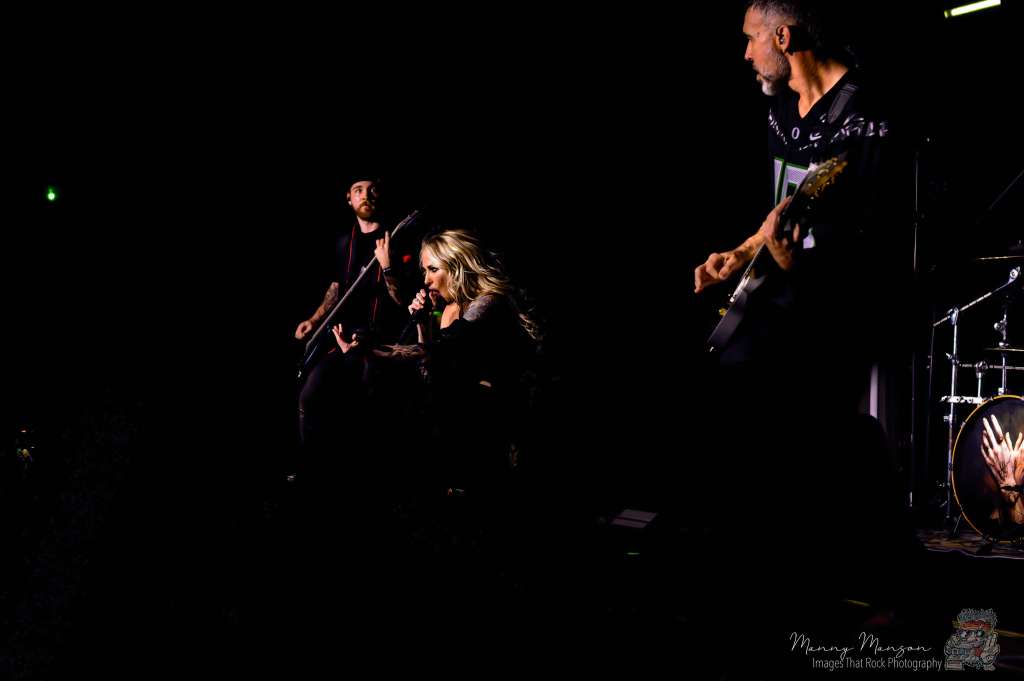
Heidi’s vocal delivery was remarkable, shifting effortlessly from tender, almost whispered lines to soaring, impassioned crescendos. Each transition carried weight; the audience hung on every syllable, reacting physically and emotionally. Her interaction with the crowd was electric—eye contact, gestures, a hand extended as if to pull them into the song. It was intimacy and intensity in perfect collision, making the track feel like a shared secret shouted into the night.
The bridge offered a chance for subtle interplay. Henry’s guitar arpeggios shimmered, slightly harmonized against the bass and subtle cymbal work, creating tension and expectation. When Heidi returned to the chorus, it wasn’t just a musical release, it was a release of energy, emotion, and collective presence. The pit moved organically around her, bodies spinning and reacting, feeding back into her performance, pushing it further, making it feel alive in a way few tracks manage.

By the final lines, “Lost in Your Touch” wasn’t merely a song, it was a moment, an event. The crowd’s response, screaming the chorus back to Heidi, made it feel like a shared creation, every growl, every melodic line amplified by the physical and emotional energy of the room. The track proved that Butcher Babies could fuse melody and aggression, intimacy and chaos, with absolute mastery.
The opening of “Black Dove” hit like a gust of wind, carrying with it the weight of Butcher Babies’ emotional intensity. From the first note, the song demanded attention, a slow-burning storm that built with deliberate intent. Henry Flury’s guitar was saturated but measured, each chord ringing with tension and subtle dissonance, while Ricky Bonanza’s bass threaded the low end through the room like a slow pulse, grounding the song in darkness. Dave Nickles’ drumming was equally nuanced; kick patterns hit with deliberate force, snare cracks sliced sharply, and cymbals shimmered like shards of glass, emphasizing the song’s haunting texture.

Heidi Shepherd’s vocals were at the heart of this performance. She started with a restrained, almost whispering intensity, letting the melancholy of the lyrics sink in. Then, as the chorus approached, her voice soared with clarity and power, not just cutting through the instrumentation but wrapping the crowd in a visceral emotional embrace. Her phrasing was impeccable, alternating between controlled melodic passages and raw, serrated screams that erupted at just the right moments. Every line felt earned, every breath charged with purpose.
The band’s interplay was especially noticeable here. Henry and Ricky danced around each other’s lines, the guitar weaving melodies over the driving bass, while Dave’s fills accentuated the emotional peaks without ever overpowering the delicate moments. Subtle feedback and harmonic layering added texture, making the live rendition feel bigger, yet more intimate.

Mid-song, the arrangement stretched. The band allowed space for the notes to resonate, for Heidi to let her vocals linger, almost daring the crowd to remain still. And the crowd answered in kind, silent attention punctuated by waves of collective reaction, an unspoken conversation between performer and audience.
When the chorus hit full force, it was cathartic. The guitars sharpened, the bass rumbled, the drums pounded, and Heidi’s voice cut through with blistering clarity. The dynamics swung with precision, quiet tension giving way to explosive release, the song breathing like a living organism. By the final note, “Black Dove” had transcended mere performance. It was a full emotional journey, blending aggression, vulnerability, and the raw intensity of Butcher Babies at their most evolved.
The moment “Spittin’ Teeth” hit, the O2 Institute erupted. Gone was the subtle tension of “Black Dove”, this was raw, unbridled aggression, a return to the primal ferocity that has defined Butcher Babies from the start. Henry Flury’s guitar screamed through the PA, each riff jagged and razor-sharp, biting into the room with precision. The palm-muted rhythms punctuated the verses like snapping whips, while Ricky Bonanza’s bass thundered beneath, giving the track a visceral foundation that made the floor vibrate underfoot. Dave Nickles’ drumming was relentless—blast beats and rapid-fire fills alternating with controlled pauses, setting a ferocious pace that dared the crowd to keep up.
Heidi Shepherd prowled the stage with a predator’s grace, her energy magnetic. She shifted effortlessly between guttural growls and sharp, explosive shouts, riding the riffs like a second instrument, accentuating every staccato hit and syncopated rhythm. Every line was spat with intent, every scream a visceral punctuation. Her eyes locked with fans at the barriers, dragging them into the chaos, making each person feel the song was delivered solely to them.

The band’s cohesion was undeniable. Henry’s leads twisted around Heidi’s vocal lines, creating tension and release in perfect tandem, while the rhythm section maintained an unrelenting pulse that never faltered. Even the spaces between the riffs were charged, with silence and feedback working as additional instruments, amplifying the track’s unpredictability.
The pit responded immediately. Bodies collided, twisted, and spun, feeding back into the energy on stage. It wasn’t just movement, it was communion, a physical manifestation of the track’s aggression. The song’s chorus hit with thunderous force, vocals cutting through with searing clarity, drums and bass locking in to amplify every syllable. By the final breakdown, “Spittin’ Teeth” had transformed the room into a controlled storm, leaving no doubt that Butcher Babies could still deliver ferocity without compromise, raw power tempered by precision and intent.

Before the first note of “Last December” rang out, Heidi Shepherd paused, her presence commanding the room with nothing more than a look. She spoke, briefly, candidly, about the darkness behind the track, mental health, isolation, and the weight of personal struggle, before letting the music take over. That vulnerability hung in the air like a tangible force, every person in the room leaning in, waiting. The opening guitar from Henry Flury was delicate, clean, and reverberated with space, a sharp contrast to the ferocity of previous tracks. Ricky Bonanza’s bass threaded underneath, subtle yet insistent, while Dave Nickles’ drumming used brushes of cymbals and precise snare taps to create tension without overwhelming the song’s fragile core.
Heidi’s vocals were breathtakingly raw. She alternated between hushed, almost conversational verses and soaring, cathartic choruses that punched through the mix without losing emotional nuance. Every word felt lived-in, every breath and pause carrying weight. She moved across the stage with intent, her gestures minimal but precise, drawing the audience into her confessional world. The crowd responded in kind, holding their breath during the soft passages, then releasing it as one during the powerful choruses, creating a pulse that matched the song’s emotional trajectory.
The band’s dynamics were masterful. Henry layered subtle harmonic flourishes behind Heidi’s voice, creating tension and release that intensified the song’s confessional nature. Ricky’s bass anchored the verses, then surged during the choruses, while Dave’s drums punctuated each shift with both restraint and authority. The interplay between the instruments and vocals felt organic, breathing life into a song that could have been lost in its heaviness.

By the time the final chord resonated, the room was quiet, exhausted, moved, reflective. “Last December” had transformed from a track into a shared experience, proof that Butcher Babies’ power isn’t just in aggression, it’s in their ability to hold space for emotion, to make every listener feel the story personally. It was intimacy and intensity, perfectly balanced, leaving the crowd both drained and elevated.
The moment “Magnolia Blvd.” kicked in, the room seemed to shift. After the emotional weight of “Last December,” this track hit like a release valve, a swaggering, groove-driven statement that reminded everyone why Butcher Babies are as much about attitude as aggression. Henry Flury’s guitar opened with a crisp, confident riff, swung slightly behind the beat, giving the track a sense of playful momentum. Ricky Bonanza’s bass walked alongside him, fat, warm, and deliberate, locking in with Dave Nickles’ drums, which carried a relaxed yet infectious groove, punctuating the rhythm with accents that made it impossible not to move. It was LA swagger distilled into sonic form, refined over years on the road.

Heidi Shepherd owned every inch of the stage. Gone was the restrained, introspective singer of “Last December”; here she was commanding, teasing, teasing the crowd with call-and-response lines, punctuating each riff with sharp shouts and melodic twists. She moved with the fluidity of a seasoned performer, forward, back, across the stage, interacting with fans, drawing energy and giving it right back. Every vocal inflection was deliberate, from the stretched syllables that hovered over the groove to the sharp bursts that cut through the dense mix, creating a perfect balance between melody and menace.
The live arrangement let the band stretch out slightly, opening space for subtle guitar fills, bass slides, and drum flourishes that elevated the track beyond its studio version. Henry’s leads flirted with the edges of the riff, teasing harmonics and squeals, while Ricky’s bass never overstepped, but added weight and texture, giving Heidi’s vocals room to soar. Dave’s drumming was loose but locked in, the kind of tight chaos that feels effortless but is brutally precise.
The pit responded instantly. Bodies swayed, fists pumped, feet stomped, a controlled frenzy that matched the song’s infectious confidence. By the final chorus, the crowd was fully immersed, singing along, shouting with Heidi, fully participating in the exhale that closed the Butcher Babies’ set. “Magnolia Blvd.” wasn’t just a closer; it was a statement, swagger, power, and release distilled into one unforgettable performance, leaving the room buzzing, ready for whatever came next.